Thursday, 27 January 2022

Sister Angela's Veil


SISTER ANGELA’S VEIL

Mark Lain

Explained by Mark Lain

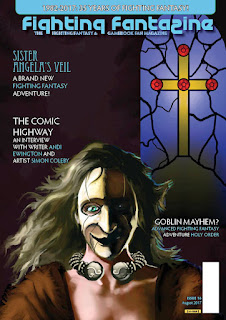
Let’s start with the really obvious thing here – I wrote this mini-FF that appeared in Fighting Fantazine Issue 16. So I will try to be as objective as possible and offer some trivia about this piece as we all my opinions on it. The original idea for Sister Angela’s Veil came from one single cameo, the chestnut orgy, itself actually a red herring that serves no purpose to the true path and, more to the point, can lead to you missing an essential piece of information later on, assuming you choose to use an item that can only be found in the orgy room. The concept of this episode is based on a true historical event that I stumbled across whilst watching an episode of The Borgias. Basically a group of corrupt Priests were duped at a feast that developed into an orgy and chestnuts were served in amongst all the frivolity. As it happens, the women involved in this event also wore veils (and little else) so this is where the overall veil idea also came from. So, essentially, I constructed an entire adventure around this one event then I subverted it by making it totally unconnected to the optimum way through. Indeed, the observant will notice a few steals from true history and/or popular culture, but that is a feature of my adventures that I do not try to conceal. The most obvious examples in SAV are: the (Borgia) chestnut orgy; Father Grandier is named after a real 16th Century Priest who was at the centre of the “Devils Of Loudon” case that was documented in Aldous Huxley’s book of the same name, itself the source material for Ken Russell’s 1971 movie The Devils; Grandier’s (potential) suicide by slashing his wrists in the bath is based on a moment in Umberto Eco’s The Name Of The Rose as is the idea of a forbidden book having its page edges laced with poison to prevent prying eyes; the Chapterhouse is based on that found in Wells Cathedral, a room that fascinated me when I frequently visited it when I was growing up in Somerset; the automaton powered by a section of the ground is an amalgam of the daleks’ power source in the first ever Doctor Who dalek story from 1963 and Tick-Tock from Return To Oz

Next came the real point of the piece – the investigation into the missing holy relic of Sister Angela De Culpa (a bit of an Enigma Mea Culpa reference in that name). The veil idea’s inspiration has already been covered but, when I realised that if you write it in the possessive (ie with a s at the end of the character’s name) you get an anagram of what would be the big reveal of the adventure:

Sister Angela’s Veil = Sister Angela Lives

Not the toughest verbal puzzle ever as the name is still evident, but the point is there. As an aside here is the question of why I called her Angela and I honestly have no idea. Maybe a subconscious angel image for religious iconography or perhaps it’s just a pretty name that came to mind and seemed to flow nicely, who knows, but The Name Of The Rose comes into play again in how YOU get involved in the mystery as there is a definite parallel with the sending of William Of Baskerville in Eco’s story and, again, I make no apologies for this.

The location was always going to be a convent in the Moonstone Hills just because I wanted it to be remote to add a sense of your being vulnerable and a long way from home. The convent layout is based on a genuine convent medieval floor plan (I forget which one or where it is), albeit simplified and heavily re-arranged. My original idea was that the convent had turned to vice since the veil vanished and that its residents were now under the influence of a malign trance from beyond the grave as, without the veil’s positive presence, the literal corruption of death had turned the convent into a brothel which would explain why there could be things like orgies going on in there (although I never fully nailed quite how this had come about in logical terms). But this idea got vetoed when I submitted the first treatment to Fighting Fantazine (they said, correctly, that it didn’t quite make sense) so, as I wanted to curry favour and my endgame was to see my work in print to get it some audience exposure, I acquiesced and changed it to an “untainted” convent but that still housed some nasties and a few people of dubious virtue.

At this juncture, let us look at the submission process that eventually led to SAV seeing the light of day in the pages of the ‘zine. After changing the treatment the concept was accepted by the Editor and I set about with gusto writing the adventure. I tend to work quite quickly once I get going so this took a month or thereabouts from first draft to submission-worthy version. I then waited 12 months to get the first set of proof-reading and play-testing notes back from the ‘zine. Various edits, questions, and corrections were suggested and I addressed these as needed (I believe there is still a section mis-link that we all missed, but it wouldn’t be FF without mistakes lol). One issue though that arose from the outset was one that I would not back down on and, subsequently, this does seem to have become something of a point of controversy with this adventure and I have seen it mentioned in pretty much everything I have read about SAV, this being the killing of the changeling in its initial baby form. The standard objection is the morality of killing a baby. I will address this as it is important and, in at least one case, I received a pretty vitriolic comment concerning this episode on an online gamebook forum. I have defended the relevance of the baby kill since the ‘zine first raised it and my justification is twofold: 1) when was FF ever conceptually moral in any way? 2) if you read on from that choice, you quickly realise that the baby is more than it seems when you engage it in a sequence of increasingly tough combats (in other words, by the next playthrough the player will know the truth of this section). So, I submitted my revised text and I waited. And I waited. A further full 12 months later (to the month), I received another set of proofing/playing notes querying more (mostly minor) points and requesting more corrections. By this point, quite frankly, I had long-since lost interest in this adventure and moved onto other projects so I no longer cared and just agreed to whatever they suggested, minus the baby kill which I absolutely refused to excise from the adventure as it is a neat trap for the unwary player (replays should show how to correctly deal with it) and it also links back to an earlier cameo so it adds some coherence too. I acknowledge that, in isolation, what you are expected to do to tackle the changeling may seem unsavoury but context is everything and I think it is a key part of the experience of this adventure.

Once the final draft was settled on by both parties, the next stage was when I was asked for an art brief for the cover, x number of internals, and x number of incidentals. I always like to have the big set pieces and any moments of awe or horror illustrated in my gamebooks, so choosing what to have visualised is usually something that is in my mind’s eye as soon as I design that particular part of an adventure. So this was an easy task, even though the project was, as far as I was concerned, very old news by then. This was the only time that I have been required to write an art brief without knowing who would be producing the art, so I had to write the briefs without the benefit of being able to exploit and play up to an artist’s style. By a bizarre coincidence, the colour cover was by Michael Wolmarans (aka Mike Tenebrae) who I have since worked with several times on my own Destiny’s Role gamebook series and he is very good at interpreting my briefs how I see them. I liked the cover when I saw it – it was striking and captured the sense of mystery that I was looking for, but I have read a lot of negative comments saying that it is a bit too grotesque or unsettling (again, since when was FF meant to be cosy?) However, and this is another unique experience for me adventure writing-wise, I did not see any of the art until the ‘zine issue was published and I was rather less impressed with the internal art by Simon Walpole which is, let’s make no bones about this, pretty poor. I have seen worse in the ‘zine and I accept that this is a fan work, but the art did it no favours at all and is far too bright and cartoonish for what I was looking for. There is no way I would have accepted any of it for a DR book but I did not have any say in the art the ‘zine matched to my text so it is what it is.

This subject neatly brings me to my personal opinion of an adventure written by me. First the positives. There are some fun moments of black humour that I enjoyed: the Potenza curse that renders your weapon useless (ahem); the initial moment where if you refuse to co-operate the book basically says “Sod you, stay outside and die, then”, but phrased better obviously; and the part where you can end up having to blunder your way through the leading of a religious service if you have killed a particular character. For those who focus purely on the polemic baby kill, I say this: I do have a sense of humour after all. And I do like the way that, as a mood piece, it is pretty taut and it definitely has atmosphere. I have seen it described as “weird” which was the intention as I wanted to do something a bit mysterious and outré, whilst also creating a fairly traditional building exploration adventure. In fact, I do think that the overall mystery-solving concept worked well. Generally, I see this as an adventure of moments and I’m not sure how well it gels, but there are several cameos that I really like: the orgy, the scriptorium, the trippy garden and its hidden tomb, the calacorm (who doesn’t like calacorms?), the automaton (which doesn’t quite fit though), and the bathroom Grandier encounter that can go any number of ways and really does require the player to tread carefully and think. When I wrote it, I liked the whipped suspended “fallen” nun but in retrospect it is maybe a bit too sado-masochistic, but then this adventure does get pretty dark (as many reviewers have pointed out) and this was heavily influenced by the 1970s Italian nun-sploitation movies that Redemption re-released in the ‘90s that are utter shite yet oddly compelling at the same time. Plus, this cameo does link to the changeling and adds even more context to what unsavoury events may have taken place in the recent past in the convent. On a similar note (and in the next chamber to the changeling) is the immured nun-wight which is another true history concept (devotional walling in of oneself) that I’ve fused into a fantasy horror trope for shock effect. I think the adventure overall has quite an old school feel, but the added violence and nastier moments do serve to pull it into the 21st Century.

Re-reading it for this review is the first time I have read it since I submitted the final draft (I couldn’t face it until now because the whole overlong saga of getting it into print was too arduous and I hated this gamebook for so long because of this) and it does stand up pretty well, but if I had full creative control and speaking now with the benefit of hindsight, I would definitely do some things differently to address what I see as its negatives/failures. There are way too many Luck tests (often with fatal outcomes for failing) and I doubt a Luck score of less than 11 or 12 will get you very far. Likewise, there are some tough fights so a high Skill is essential, especially if you fall foul of the Potenza curse and/or lose your weapon at Square One (which is maybe a bit unfair, but you are entering what you are made to believe is a holy place so it does add up). The “Angela claiming to be Amandla” moment can just seem like a typo but it is meant to emphasise the lie that links what Grandier tells you so it’s actually a key text prompt for victory, but it did not come across very well and probably doesn’t really make sense so I should have made her lying more obvious (possibly just by choosing a better fake name for Sister Angela to utter). I would definitely make the meaning of the “veil of lies” concept more explicit generally as that is the point of the title (well, that and the anagram that exposes the lies) and the “veil” maguffin. I would also write it how I originally intended it ie with the fall to prostitution angle, but I would definitely give it a more logical base as I would have the time to develop this properly as it was discarded before it got the chance to become something that worked in context. I think overall that my now negative view of this adventure is born out of the prolonged creation of it (and my subsequent disappointment when I saw the internal art) and the fact that it was never quite what I planned it to be. Indeed, when I first started planning this adventure, the process of expanding the ideas and designing the overall map was a very exciting time (especially as I knew where it was going to be printed) but after 2+ years of development hell there came a point where I was just going through the motions, which is a shame really.

There are a couple of important points to note at this juncture. Firstly, the mirror episode (step into it or smash it?) is a trick I used to include in many adventures that I GM’d for friends when we played out scenarios in my early teens. For some reason this idea captured my young imagination and its being featured in SAV is a nod to its inclusion in basically every adventure I ever created when I was young. Secondly, this is the only time I have ever used a Bestiary to mine ideas for encounters to include (in this case, Out Of The Pit for pretty obvious reasons) and we have OOTP to thank for how the whole changeling part found its way into the proceedings. I think I probably chose to refer to OOTP to try and give SAV a more “FF authenticity” feel, but I cannot be certain anymore quite why I did this. I seem to recall that the calacorm was always going to be there so the prison cells were a given and the way you can get knocked out and come to in them is very much a homage to The Citadel Of Chaos.

My personal opinion is that SAV is an average mini-FF in the context of what has appeared in Fighting Fantazine as their output (just like Warlock before it) swung from brilliant adventures to utter dross. The ‘zine has at times definitely offered better mini-FFs than SAV, but there has certainly been some that are inferior to it in its pages too. For a long time it seemed like SAV might be the magazine’s mini-adventure swansong but it looks like there is a new Issue imminent after several years’ hiatus. To close I will ask myself the question “Am I proud of Sister Angela’s Veil?” For sure, I am proud that I got my work published in the ‘zine and I do not take this for granted in any way. That the adventure got a positive comment in You Are The Hero Part 2 from one of the ‘zine’s staff just before it was released was also a pleasing moment for me. Of all the adventures I have written (both amateur and professional) this is my least favourite, but this is as much because I like to complete a project and move on rather than endlessly going around in purgatorial circles revisiting it well after the fact as it is for any artistic or quality reasons. It is way too hard and the true path is very tight but it was designed as a challenge and a mystery to solve rather than a slash-and-collect-your-way-to-victory affair. That it was never quite how I imagined it is a problem that probably bothers me more than anyone else. The bottom line is that gamebooks are created for people to play and art of any kind is designed to both entertain and to provoke/inspire a reaction from those who experience it. The fact that some people have played it and felt compelled to comment online suggests both of its fundamental purposes were achieved but I myself would never rate it any higher than a decent but flawed effort.


Friday, 21 January 2022

Warlock magazine RPG scenarios


IN SEARCH OF THE MUNGIES’ GOLD

Steve Jackson

DEATHTRAP ON LEGS

Paul Mason & Steve Williams

THE TOWER OF HADES

Dale Ashman

THE RING OF SEVEN TERRORS

Graeme Davis

THE DREAMING SANDS

Paul Mason

Reviewed by Mark Lain

Steve Jackson’s Fighting Fantasy – The Introductory Role-playing Game primer book attempted to turn the FF solo gamebook concept into a full-blown multi-player RPG, something expanded further with Marc Gascoigne and Pete Tamlyn’s three book AFF series, which was itself then developed massively by Arion Games in the early 2000s and beyond. The original Puffin FF series only produced one full scenario book for SJ’s basic FF RPG, Paul Mason and Steve Williams’ The Riddling Reaver, but Warlock magazine offered several smaller-scale FF RPG scenarios in its pages, all of which fundamentally required existing familiarity with SJ’s original FF RPG book to be able to play them.

The first of these, appearing in Warlock #5, was In Search Of The Mungies’ Gold, a hybrid campaign and boardgame written by SJ himself, which is played out on a board also included in the magazine. It additionally requires the GM to read and be familiar with The Apes Of Mauristatia, an Out Of The Pit article also included in that issue, so pretty much everything the GM would need is there bar the FF RPG book that is a given pre-requisite to have read otherwise I struggle to understand why you would be attempting to play this! Reading over the scenario will also reveal that an understanding of the plot of the Sorcery! series (if you are to make the most of the Hermit character), a copy of The Shamutanti Hills, and a copy of The Citadel Of Chaos (that, just like in that book, will win you loads of money that you are unlikely to need) are also all needed to be able to include absolutely everything that this scenario asks for. The scenario’s premise itself is simple. Mungies are apes who like to collect gold (for some reason that even the text admits is not really clear other than they just seem to like stealing it) and rumours of their gold stash are doing the rounds in Kharé. This has attracted the attention of the group who are about to play and they get in a boat, sail across Lake Lumlé, and thus begins the game as they land and search around the board looking for the fabled horde. The GM decides in advance where on the board to locate the 16 game-defined encounters and the players make their way from board square to board square as they explore the area and the GM does have the option to add more of their own material if needed. The instructions do insist on six characters (possibly to make some of the tougher encounters easier maybe, otherwise I can’t understand exactly why) and any shortfall in players has to be made up by NPC hired hands played by the GM who are bribed to do the bidding of the players in the group, player Skill tests and suitability of potential financial rewards for the NPCs permitting. The instructions are helpfully clear on how to go about successfully planning the way encounters are located on the board, and importantly point out that creatures should be logically placed in their habitats, encounters with NPCs who can advise on finding the gold are placed in reasonable positions (eg: they can be found near the boat to get an early hint or somewhere in the wrong direction to put the adventurers back on the right track), and that the gold is not put somewhere totally unfair (in the boat being the example the text gives - as there are two encounters that must precede the gold square I can’t really see how this can happen, but the text’s point is admittedly a valid one, all the same).

The encounters themselves are what makes this piece interesting as the four species of apes of Mauristatia are well designed and unique, especially the Wraith Apes who are harder to fight at night than if encountered during the day and are less likely to attack during the day, which could be handy if the players happen upon them in daytime (although this would largely be through sheer luck). Indeed, the GM must track the time of day as the characters move about the board and, in keeping with Sorcery!, if they go a day without eating they will suffer a Stamina penalty so there is added realism in that respect and managing the 5 Provisions each player starts with is a key part of being victorious, although finding the bomba fruit will definitely help in this respect. The Champaque is also intriguing in that it can grow progressively stronger if certain conditions are met. The titular Mungies themselves can only be fought if a player has a Skill of 10+ otherwise they will just run away as they are very fast so a group where every player has lower Skill scores can in theory have an advantage, especially as there are seven Mungies to contend with. Conversely, a weak party may struggle against the lethal Manticore that can be found if players are particularly unfortunate!      

In terms of difficulty, notwithstanding the Manticore and potential instadeath at the hands of a Blade Tree, this scenario is not too hard, and the added option of using the GM-controlled NPCs (if there are any in the party and they can be convinced to fight on the players’ behalf) makes this all the more the case, and a tactical party will think to use this and the players should be thinking tactically anyway. Slightly harsh is the rule that Escaping is not allowed (especially if the players find the Manticore), but it does allow the various traits of the different apes etc to come to the fore much more. The relatively small size of the playing area (and the possibility that the party could just blunder their way straight on to the correct path to the gold with no real resistance) does make for what is likely to be a short game but the GM does explicitly have the option to include the contingency plan of including the return journey back to the boat should the players find the treasure too quickly. Obviously a savvy party may well opt for the same safe route back but the GM could of course subvert this and reorganise some unused encounters that have arrived on the scene in the intervening period. The return journey coda adds a double-jeopardy factor as the boat is found to be damaged meaning only one player can ultimately leave with the gold so it becomes a winner takes all situation which does unravel the collaborative aspect but is something of a potential twist in the tale (unless of course the party just decides to give up on the gold and abandon it in favour of camaraderie, thus completely defeating the object of the exercise).

The all-important replayability of course comes from the randomness of how the board can be laid out (just like SJ’s subsequent WOFM boardgame) which does make this different to most pre-designed scenarios as they can be very proscriptive and there is a noticeable absence of scripted prompts to read out to the players which emphasises even more the boardgame feel of this piece. However, I cannot help feeling that there is an element of lazy design with the “refer to this or that book for ideas” element and, although the play area is small, alternate pre-written options for encounters to allow subsequent playthroughs to be very different would have been a nice add-on. That said, the inclusion of the various apes does make this more interesting and worthwhile than it would otherwise have been and there is a clear sense of place to the setting which overall makes this a decent first stab at a scenario from Warlock magazine. Personally I would have liked something longer for players to get their teeth into more but the return journey can allow for the unused material to still get included if needed and will extend the game’s duration, so SJ was thinking on his feet when it came to making this more than fifteen minutes’ worth of play. Incidentally, a gamebook adaptation of In Search Of The Mungies’ Gold was included as the mini-FF in issue 4 of Warlock’s spiritual successor Fighting Fantazine in 2010 which greatly fleshed out the original premise and concepts.

Warlock #7 gave us the next of these scenarios in the form of Paul Mason and Steve Williams’ Deathtrap On Legs, a sequel to Deathtrap Dungeon that follows directly on from the end of that book and probably works best if one of the party has genuinely just completed it (the instructions do say to do this) given that the concept here is that the winner of The Walk has just slept off his or her ordeal and is joined by a team of groupies (the rest of the playing party) who watched the victor enter and subsequently emerge alive from the Trial of Champions. The groupies have to join forces with the victor and, as one, they head off to an inn in Fang where the group is mysteriously invited to get some R&R at the tower of one Badedas the Blue (shades of Tolkien in that naming convention). However, little do they know that the tricksy Baron Sukumvit has spiked the victor’s laurel crown with a smelly juice to allow him to be tracked by a vicious Crocosaurus ridden by a Gumar hunter whose job it is to retrieve the 10,000 Gold Pieces prize money that Sukumvit is not best-pleased to have parted with and to silence any possible news spreading of the besting of his famous Trial (in other words, to kill the victor), so the whole thing is a set-up. Tangled up in all this too is Jaiphrai Ah’cha (one of Mason-Williams’ many punny characters that resurface in various of their FFs and is an alternative identity of their favourite creation, the Riddling Reaver) who is despatched to keep an eye on proceedings and make sure the Gumar hunter comes out victorious at the end of all this. As an aside at this point, it is worth noting that it is in Deathtrap On Legs that we discover that the character who leads contestants into the Trial is the very same Mr Ah’cha so that is a nice bit of lore to come out of this piece. I think for authenticity, not only should the victor be played by an actual immediate winner of Deathtrap Dungeon, but the groupies should also be played by characters who have been a party to the entrance and emergence of the same character - some simple general background given to these players by the GM would suffice to set the scene for the non-victor players, but this would definitely add to the immersiveness and understanding of who is who. The text does state that the victor character can carry over anything they found in Deathtrap Dungeon (which makes perfect sense) but, bar any obvious “open use” items such as food or weapons, their usefulness would have to be edited in as custom moments by the GM for this aspect to really work, but it would definitely add something and drive the idea of continuation more effectively.  

So, what of this highly-promising idea then? Well, this is the problem because there is not actually much to this scenario other than the gambit of getting to the wizard in one piece via a plain where nothing happens unless the GM throws in a couple of random plains-based encounters of their choosing, a forest where the first crocosaurus harassment takes place, and the tower episode which does have some surprises but is the only decent part and even then only really breaks down into two events plus the necessary crocosaurus and Gumar killings. An added problem is that most of the players will be asleep during the crocosaurus attacks in the forest as only the player on watch will be awake to experience what is going on, although several visits from the creature can happen so that different players can be awake to experience the same moment which would add some context. Further exacerbating all this (or the lack of “all” in this) is that, other than the rather strong reptilian beastie with its Sk 14 St 18 stats, hardly much of a challenge is presented. Jaiphrai does a vanishing act, Badedas has been turned into a fairly weak zombie, the Gumar is hardly strong, and an inconsequential wild boar vs freaking out Hillman moment is not going to cause a party of the intended 3-6 players much trouble. Granted there are a couple of neat but very slight moments where the GM gets to have some grunty gesticulatory fun trying to articulate the Hillman telling the group about the crocosaurus he has seen passing by (if they can interpret this at all) and inside Badedas’ tower is a pool not unlike that where the famous Bloodbeast resides in DD (it’s actually a teleporting portal in this case though) but any excitement that could be caused by the possibility of another Bloodbeast encounter is dashed quickly.

In essence, this can be summed-up as, basically, off the group goes, they try and avoid being killed by the crocosaurus/hunter, they get to the tower hoping to meet their host, they find the maguffin of the piece (that Badedas is dead and they have been duped into going there so they can be killed off), and then it all ends very suddenly. It is kind of like an alternate extended ending that got deleted from a movie of DD and has been included as an extra feature on the DVD edition. It is unlikely to take long to play (maybe as little as 30 minutes) and definitely needs the GM to add more random (ie non-plot) cameos in to put some meat on it and get around the lesser issue of everything being directly related to the plot which does detract from the realism that unconnected encounters and moments in an exterior setting should give. It is far less imaginative than we have come to expect from the Mason-Williams team but it does have the “big reveal” ending that Mason was always a proponent of in his FFs.

In conclusion then, Deathtrap On Legs is fairly inconsequential overall. It is a good concept in the way it follows DD in a potentially intriguing manner but sadly it makes nothing of its possibilities and little more can really be said about it. The title is pretty neat though.

The Tower Of Hades, written by reader Dale Ashman and presented in Warlock #8, is an altogether lengthier and much more involved affair than the previous two efforts and, in spite of the action taking place all in one location as opposed an outdoors trek like In Search Of The Mungies’ Gold and Deathtrap On Legs, it feels much bigger overall, largely due to the sheer amount of material and content incorporated into this scenario. It takes another simple premise (the group’s friend, Belkor the Dwarf, has failed to show for a rendezvous so they go to where he was last known to be and try to establish what has become of him) but this time makes way more of it. Initially, the group explores the inn where Belkor likely disappeared (the Horizon Inn) and unearths a mysterious cult at work. From there, they find an entrance hidden below the inn buildings which leads first into some underworld caverns, and then into the Tower Of Hades of the title. This may not sound big map-wise but there are about 40 areas to explore, which is a lot for a “mini-scenario”. There is a lot of sleuthing required on the part of the players and this is far from a simple adventure but the inn section is not especially tough and acts more as a prelude and basic intro to the concept. It is when the group enters the actual tower itself that this really erupts into a seriously challenging scenario.

The tower is on several levels and, as the players explore, the real scale of what is going on becomes apparent. In many ways this has echoes of what would come with Zharradan Marr’s marranga abominations in Creature Of Havoc as the big baddie of the piece (Ar Gadayon, an evil sorcerer) is conducting vivisection experiments on various creatures and unfortunate locals with a view to creating an unholy army of nasties to unleash on the world (shades of another SJ effort there then as this is not dissimilar to Balthus Dire’s shenanigans in The Citadel Of Chaos). An interesting point to note here is exactly what world this is as this scenario is set in something called “The Outlands” and appears to have no Titan link of any kind. This is not a problem, on the one hand it does make it exist in a vacuum within the FF cannon, but it does at least show originality as the author has not tried to piggyback on another author’s work – potential then to genuinely play this as a standalone scenario but I admit there is no real reason why the GM could not retcon The Outlands into the standard FF worlds somewhere to incorporate it into a larger campaign. But I digress, let’s get back to the tower. Each level of the tower has numerous rooms to explore as the story reveals itself and the players must piece together the ever-increasing amount of evidence they find to a) rescue Belkor, and b) take out Ar Gadayon himself. Some elements (especially some power spheres and deactivating a light beam) are complex and would require a lot of lateral thinking by the players which makes this feel more like one of the more elaborate D&D modules and is a far cry from either of the previous two Warlock scenarios in this respect, and these sections do require very close and repeated reading by the GM to fully understand what is being described. What I really like about this piece though is how focussed it is on its concept and how well-designed and developed this is, from the hierarchy that can impact events in various ways (dress as a higher member of The Order that makes up Ar Gadayon’s acolytes and you will be afforded more respect and some moments will be made easier than if you dress as a lower member or don’t opt for disguising at all) to the gradual revealing of the vivisection aspects, through the way the tower acts as a self-contained living space for the sorcerer’s minions (both human and Ogre), and even the way Ar Gadayon himself is presented as a cultured insane genius of sorts. Depending on how skilfully or clumsily the players negotiate the game map (from even the very first part in the inn) this adventure can be made easier or harder and some members of the group can easily get captured and become destined for torture/experimentation themselves unless the other players can find where they have been taken so the chance of the group getting split up is pretty high which will obviously make things harder. Tangling with the Order too early in the piece can be disastrous (and the Order are very strong opponents with stats in double figures) as can doing obviously stupid things like antagonising a massive regular whose table at the inn is permanently reserved for him or trying to fight the local militia who can show up if the group causes too much trouble in the inn section. The inn section is largely about ground work in introducing what is going on and trying to keep the group in one piece before locating the tower and unravelling the crux of the piece.

Something that makes this stand head and shoulders above its two predecessors is the focus on plot (Mungies is just a smash-and-grab exercise and Deathtrap has a concept but it barely gets used to any good effect) as the players discover more and more as they progress, whilst remaining fixed on the original aim of finding Belkor. Once it becomes apparent what is really happening a two-fold challenge comes into play of rescuing the group’s friend and also vanquishing Ar Gadayon. Obviously Belkor can be found either alive or dead (if the former, then he is a usefully strong NPC to have in tow for the later stages of the game) so there may only be one aim albeit tinged with revenge, but the ultimate victory condition would be to defeat Ar Gadayon and have everyone including Belkor live to tell the tale. But any kind of win in this adventure is hard fought as (and the intro even warns of this) the scenario grows increasingly harder as you get further along and the Final Act really is very hard indeed (way more so than Mungies or Deathtrap), especially due to the amount of logic and thinking out of the box required from the players to negotiate the tower given that the earlier two scenarios were mostly just killing opponents to get to the goal, whereas this one asks the players to divine how to operate and/or deactivate mechanisms, how to best approach situations, etc etc. In other words, this is a much more nuanced and traditional take on role-playing where brains will win over brawn even though sheer strength is still needed in places (and strength in numbers for the multi-opponent fights with tough enemies). To curb the psychotic approach in the inn section though, the number of spare seats at each table in the inn is cleverly limited so the full party cannot join any one table together, which is a neat touch that also requires the party to separate and gather intelligence to bring back to the group. Conversely, in the tower any combat is better-handled collectively as the difficulty ramps up but, again, combat should be avoided if only to be strong enough to handle the end game.

I have noticed one glaring error early on where a group of adventurers can be met in the inn – the text says there are six of them then goes on to only ever describe five of them (a similarly famous error existed in Blade Runner so is this a gag?) but a sensible GM would notice this and either add a sixth or just tell the group there are five, so this is hardly a crisis. There is some fun to be had by the GM in playing the barman, Belkor, Ar Gadayon, and the various cultists and ogres, and everything feels very full and fleshed-out in this scenario. The content of the tower in particular is very original and intriguing material. Admittedly, it could be a long session to play, especially given all the problem-solving, but RPG scenarios are more often long than short (brevity was a criticism I levelled against the previous Warlock offerings) and that just makes for a more satisfying adventure with lots for the players to get stuck into. There is also no real need for the GM to improvise in this scenario and nothing needs adding to make it more exciting to play. In fact, the whole thing is so focussed and neatly-packaged that any random stuff would feel at odds, plus where would you put it anyway given the play map here?

This scenario was the one that raised the bar for Warlock’s FF RPG offerings in my eyes. It feels complete, is very well thought-out, is a serious challenge for the players, and is full of logical and interesting moments. It is arguably a bit too difficult at the end, but this just makes it more climactic and the mixed emotion element of Belkor being either alive or dead at the end makes it all the more worthwhile. Ar Gadayon’s mini-empire is fascinating as is what he is up to and his tower is well-worth a visit. Really good stuff, particularly as this was a reader submission rather than a professional effort by one of the GW inner circle.

The third consecutively-published scenario (in Warlock #9) was Graeme Davis’ The Ring Of Seven Terrors and was a very effective treat. Very much a cameo to be incorporated into a larger overall campaign (otherwise this may feel a bit random and incomplete), this is effectively a sequence of seven challenges bookended by the over-arching idea of a burial barrow surrounded by a stone circle. The quality and interest here comes in the variety of shifting environments and encounters inter-related to the way the stones and the tomb morph from one form and appearance to another, each transition designed to suit a theme. Overcome one challenge and the circle/tomb transforms into its next configuration, it’s as simple as that, but the nature of what the players are faced with is far from simple as each presents a “Terror” that the party must contend with in various different ways.

First up is War, made a little trickier by the potential for the group to become separated and part of it being unable to see what has become of the other part. This first section generally goes easy on the players though and involves an easy fight on a post-battle scene with a group of skeletons equal in number to how many players are facing them. A gentle opener then. This is followed by Famine, the scene having transformed into a desert wasteland, the stones and tomb now sandstone. This one is deceptive as it seems there is no threat, but in actual fact Sand Weevils are eating the group’s supplies and the result can be serious if bitten causing terrible hunger and worse. Next the scene switches to a sea of vile brown slime, the barrow having become a mudbank and the stones dead tree stumps. This bleak locale is Plague and the party must fight a group of Decayers (again equal to as many as there are in the party) which can inflict a slow-reacting rotting disease further down the line (another reason why this is best played within a larger campaign so that the ramifications can really be felt to full effect). If everyone is still alive (and they should be as the first three stages are very survivable) the group next faces Madness as the tomb becomes a black domed crypt supported by seven pillars (the stones’ latest form). The exercise here is to deal with a Banshee, complete with its ability to mesmerise and render defenceless any hapless player caught in the spell of its wail. The Banshee is the first physically strong opponent here with Sk 12 St 12 and can only be fought by untransfixed players but the rub here is that she will only attack mesmerised characters getting autohits so this is the first stage that could really separate the strong from the weak and potentially deplete the party. Assuming at least some players survive, we move onto Death, the scene unchanged but it is now night and signs of other tombs and burials can be discerned. All the group’s weapons are now made from silver and, as before, a number of opponents equal to the current party headcount appears, this time Crypt Stalkers. GD has been generous here in giving the group the required magical weapons to fight these opponents otherwise this would have been wildly unfair and the Crypt Stalkers are pretty weak (Sk 8 St 6) but they do have special attacks, but again this is offset as any Crypt Stalker that gets a kill will vanish. Stage 6 sees a wall of flame appear around the circle and the stones/tomb are now made from a red-veined black stone which smokes ominously. The group’s weapons have also taken on the same appearance being black metal with red warping streaks. This disturbing and weird scene is the prelude to a fight with a Hell Demon with Sk 14 and 4 Attacks, so we are in seriously tough territory now (quite literally Hell). As a gesture of benevolence, the Demon’s Stamina is calculated proportionate to the number of players +6 ie given that this scenario is suggested for 3-7 players it will have St 9 at its weakest and 13 at its strongest so, in spite of its very high Skill and its multi-attacks, it can be physically not too extreme a proposition. If the group are still standing after this, erm, hellish experience, there is a bright flash and everything turns white, the ground, barrow, and tomb all now being mirrored as the group faces the seventh terror: Self. Each player must fight a duplicate of themselves with the same Skill and Stamina as they have. Once each doppelganger is dead everything goes back to how it looked at the start of the scenario including (generously and possibly relievingly) the reincarnation of any players who may have died at any point in the series of ordeals (albeit with only 1 Stamina point!) To allow for some continuation into subsequent scenarios (and in keeping with the famine episode) there is a narrow chance that some players may still have their silver or red/black sword and its relevant stat bonuses, which is a nice touch and helps this feel part of a bigger campaign/story. Survive this and the party has defeated the Seven Terrors. Ah, but then comes the final challenge because, remember, this started out with the players finding a stone circle with a tomb at its centre which now opens up to allow them access. In they go and they find the occupant who has become a Death Wraith. He is not especially strong but the restricting interior of the tomb means only two players can viably fight him and, unless one of them was lucky enough to find they still had a magical weapon, they must make a grab at one that is to hand otherwise they cannot wound this last nasty. If they do succeed the reward is lucrative and worth it.

What this scenario has that the others discussed so far do not is a relentless pace with no let up or time for the players to draw breath as one encounter follows another in quick succession. The energy and tension grows as the cameos get ever tougher and more foreboding and the final analysis where the players literally face themselves is very clever (in fact, the whole thing is very clever). There is also far more invention on show here than in its three predecessors and Davis was at the time quite an exponent of the FF RPG concept having contributed several articles to Warlock developing the system. My personal favourites from the Terrors are the grim and gloomy Plague, the vicious Hell, and the highly original Self (everyone’s worst fear is to face themself in mortal combat lol), but everything offered here is great material delivered with atmosphere and impact to spare.

Another point of interest here though is the art, as every one of the encounters (bar Self which would be impossible to illustrate) has a single illustration to accompany it and these here are by Trevor Hamond, an artist with a truly unique style, but whose work for FF was restricted to three issues of Warlock only and nothing else. This is a huge shame as his art is very impactful and striking, looking to me almost like a primitive version of Gary Ward and Edward Crosby’s woodcut style from Caverns Of The Snow Witch, and he should have been used more in my opinion.

The Ring Of Seven Terrors is a superb scenario which, if built into a larger campaign as an extended episode, would be a brilliant inclusion to both reward and penalise the party, and is the first really essential FF RPG scenario from Warlock magazine.

We would have to wait until what would prove to be Warlock’s swansong with Issue 13 to get another FF RPG scenario from its pages, the high concept The Dreaming Sands by Paul Mason, itself another part of PM’s ever-growing Riddling Reaver-related story arc. This piece does not specify how many players it is designed for which makes it less proscribed in that sense. It also starts with a sure-fire crowd-pleaser by setting its opening in Port Blacksand’s ever-popular Black Lobster tavern. All very promising then. The concept is that Lord Azzur hires the group to resolve a “plague” that has beset the city. The nature of this plague is within itself alone a very clever idea as peoples’ nightmares are becoming reality and wreaking havoc. At the bottom of all this is of course that pesky Reaver again and, whilst no prior knowledge of his activities is necessary, it would definitely be of benefit to put all this in a wider context and make it feel like an extension of the adventure the players would have hopefully already experienced in The Riddling Reaver. The group is hired to locate the source of the problem and eliminate it by heading south from Port Blacksand to see what they can find. Before leaving the city they cross paths with Angelica (the Reaver’s daughter) who masquerades as a helping hand but is actually there to try and scupper them and prevent them reaching what turns out to be the Reaver’s castle.

The adventure per se involves a plains trek divided into several pre-defined sections (no GM-determined layout this time around, which does make this something of a one-shot in design terms once the party has won), each with a set encounter/cameo in it. There is a well-balanced mix of the conventional and the unique here with wolves/elves/centaurs/ogres/trolls offset by previously unseen creatures such as Nikrechauns and the Lords of Gond (the leader being the very powerful Naijem-Nosoth). Obviously the unique material is the more interesting: Nikrechauns are sort of pre-school Leprechauns that are far less troublesome but will turn into Leprechauns once they have got the requisite pot of gold together, and the Naijem-Nosoth (an anagram of Jamie Thomson for the more observant) is lethal but is also vulnerable to high-pitched noises to give some fairness to him being potentially over-powered otherwise. However, the standard stuff is also well-handled with a Dark Elf encounter in particular being very neat and totally in-keeping with the plot as they are convinced the players are a dream and do not in fact exist! The Centaurs are fun too as they are basically on a sort of religious pilgrimage. What may be becoming apparent in all this is that killing is not necessarily the way forward in this scenario (the Trolls are so stupid that they can just be baffled into non-aggression, for example) and PM’s preference for plot and concept over strong-arming one’s way through is very much to the fore again here. That said, there is Angelica to deal with sooner or later and she is very strong (Sk 14 St 20) and a force to be reckoned with.

A really interesting mechanic here is that the actual location of the Reaver’s castle is never given away and with good reason: the players must either visit every area to reveal it or, and I think this is probably PM’s intended approach (assuming the players can think like him and attempt this) is to roll a dice to decide where to go next and, lo and behold, his castle will appear suddenly. This is an original way to handle the finding of the player’s goal and adds the randomness of the whole Reaver concept to the “true path”. Even more randomness comes into play once the players are in the castle. There is no castle map and the GM simply improvises an intentionally impossible and unmappable design. Again, random choice rather than trying to be rational and put any sense of reason into the equation is the only way the party can locate the Reaver himself. In his chamber is the source of the problematic nightmares (a sorcerer called Alokurga) and, in itself, this is easy to resolve assuming the players can use a lateral thinking technique to get him out of his dream state (which causes his death at unseen hands). However, the Reaver then appears (the owner of the unseen killing hands of course), goes into a typical bad guy confessional soliloquy, and promptly vanishes. And that’s that.

But, there is a whole other level to this scenario too: dream attacks. And this is where the GM really comes into play. Whilst the map of the scenario and its various encounters is set, the dream attack concept is not and the GM can choose how and where to attack the players with dreams of whatever kind he or she can conjure up in their imagination. This is where it can get really interesting (and potentially terrifying) as the players will quickly start to question what is real and what is not, making the elements designed by Paul Mason seem all the more threatening and unpredictable. Indeed, the over-arching theme here is the blurred line between reality and dreams and, as the aim is to stop the dream plague that has hit Port Blacksand, it makes perfect sense to have the players getting affected by this too otherwise it is just a means to an end that could get forgotten in what PM is clearly trying to avoid from becoming little more than a seek-and-slay exercise.

The dream aspect is quite demanding on the GM but there is fun to be had in trying to be as warped as possible with this aspect. As with The Riddling Reaver, the GM is also expected to come up with cryptic ways of responding when playing the part of the Nikrechauns, which could be a challenge requiring some decent pre-planning. But these are just two examples of how original and different this scenario is and, when handled as intended, this is a great little adventure for a sharp-minded group of (probably more experienced) players. Mason’s usual tendency to emphasise plot over play is not as evident as usual here and he really gets the balance right between concept and a really satisfying adventure. For sure, this is more cerebral than most scenarios and is not really suitable for a group that just wants to kill everything and collect the spoils, but this is a welcome change and if GM’d properly this is a very intelligent scenario to both play and referee. Kudos to Mason for taking a risk that paid off with this.

So, Warlock made a concerted effort to develop the FF RPG concept which deserves credit. However, the results were very mixed, ranging from pretty empty and uninteresting to extremely good. There is simple stuff here and very intelligent stuff, which would suit a variety of playing requirements in terms of what people are looking for. Some of these are very set by the creators, others are more freeform and require greater input from the GM. Each has its merits but some are definitely way better than others. But for variety, I cannot fault what Warlock tried to do with these efforts.
Thursday, 31 December 2020

Short Stories


Short Fiction

Various Authors

Reviewed by Mark Lain

Let’s put some clarity on this subject from the outset. Warlock magazine and Fighting Fantazine have sporadically included short stories and comic books during their runs and I think these should be regarded as relevant for discussion. To keep some structure to the scope of this post, I am including short story material that was featured in either publication (be it directly or indirectly linked to the FF canon) and serious-toned comic strips only (ie the comedy strips are excluded, that is Arkenor And Max and Derek The Troll, other than to acknowledge right now that they are both genuinely funny), but that still gives a decent amount of material to discover.

Let’s begin with Aida Rintarou’s The Book In Which You Are The Hero, only two parts of which have been published and even then in rather scattershod fashion in Fighting Fantazine Issues 4 and 8, which meant the two instalments appeared with a gap of 16 months separating them. Whilst there is very little of this available to us it is worthy of some analysis as there is a lot going on here. The concept is that each FF book is a chronicle, in scroll form, of a “brave person” vanquishing a baddie. The scroll is torn apart and reassembled in randomised numbered section order (get it?) Fast forward to New York in 2020 (shades of Highlander, perhaps) where a combat with swords is in progress: a flashback of one of the characters discovering one of the “torn apart” scrolls and completing it to be rewarded with an item for “[completing] the record of truth”. There is a wry comment in the text that “I was starved for entertainment and became enthralled by the strange book” (weren’t we all) and completing the book actually hides it inside you – a reference to FF being a part of us all, maybe? On absorbing the book and becoming one with it, Zagor’s power source passes into the reader as his cards are the power of the wizard that is inside the book. (This is all very clever stuff). Next the protagonist receives an email from “The Baron” who is described as a “super-famous businessman who had become a billionaire in the IT industry”. Hmm, who could this be then? I’ve suggested before that Baron Sukumvit is Ian Livingstone’s alter-ego and the IT industry businessman moniker certainly fits this particular un-named Baron. The Baron tells the protagonist that they must gather together all 59 books to win a $59 million reward (which, if the current soaring prices are anything to go by will very soon not actually be enough to manage to buy a set of the 59 original Puffins!)  At this point the strip becomes a bit baffling as it explodes into the usual manga muddled confusion with a final page that makes no sense at all to me (and I wish to add a caveat here that no manga or anime has ever really made much sense to me). I think it is something about the protagonist using a non-FF ability, but frankly it is anyone’s guess as to how Part 1 ends. Part 2 recaps the understandable parts of the first Part and tells us that you can manifest the power gained by absorbing each book at will and our lead seems to opt to use this power by giving herself a huge pair of tits (oh manga, you are so mauve lol). So, the end of Part 1 did just about seem to be another absorbing that seemed to be the main character’s life force (I think) and the Highlander comparison is hard to avoid again. And then this Part suddenly ends with the same large-breasted girl again and some Japanese script that may or may not a) be important, and b) shed clarity on whatever is now going on, but I can’t say as I don’t read Japanese.

This story is beautifully drawn in a classic manga style. It suffers from a few bizarre sentences and typos (written by a Japanese person presumably and in what is effectively a fanzine, so we have to forgive these niggles), but this does not make it make less sense than it already does(n’t) anyway. This seems to be FF Highlander in manga form which is an interesting mix of ideas and concepts and the whole idea of each of the 59 books forming a single text that was deliberately disordered is a neat one. The piece is not as intriguing for me as the similarly two-parts-are-all-we-have-to-go-on The Book Of Runes proved to be, but it still deserved to continue and it definitely had the potential, even though it does seem to be defunct given that there were plenty more issues of the ‘zine to appear after its second Part, without any further instalments materialising. Given that the scroll was broken into 59 parts, does that mean that Rintarou intended this to be a 59-part epic? Ambitious if that was the plan, but was that ever really likely to come to fruition? Either way this is lovely to look at and I have to applaud the ‘zine for including something very different to the usual short story submissions that appear in fanzines and reminds us that FF was/is as huge in Japan as it was in Europe.

The aptly-named Out Of The Frying Pan, which was printed in Fighting Fantazine Issue 2, was penned by Ian Brocklehurst who would soon after go on to write the much longer episodic Aelous Raven And The Wrath Of The Sea Witch, also for the ‘zine. Frying Pan is a taut little piece concerning a group of survivors from a Lizard Man attack on their caravan en route to Kaynlish-Ma, who descend into the forest seeking cover but find rather more than that as our hapless group blunder straight into a second ambush from Marsh Goblins. There is a certain gallows humour to this concept and the ironic early comment that “our fortunes are improving” quickly becomes Famous Last Words. It is notable that this short is contemporary with the Siege Of Vymorna (the Lizard Man presence is linked to this), which positions this story as happening at the same time as the events of Battleblade Warrior and it is always good to see fan fiction being legitimised like this by directly connecting it to canon in this way. I cannot avoid mentioning that there are some typos, missing conjunctions, and awkward sentence structure (possibly through missing and/or misplaced punctuation), but this is fan fiction so we cannot expect perfection in what is actually a very well-written story with an epic and dramatic tone and a frenetic pace that really makes you feel the desperation of the characters’ predicament. Even more so, this has to be hailed as a success given just how short it is and how much action is packed into its brevity. The text is punctuated by violent action and the constant dashing of the protagonists’ hopes of safety makes the title wholly suitable. Indeed, this is really quite a graphic and visceral piece with a tone of impending doom and a downbeat ending that neatly subverts the reader’s expectation of things coming out right somehow. The title is perfectly matched to the content, which is basically a series of instadeath situations, which just adds to its feeling of connection with FF as a concept. This story really did deserve better proof-reading but that is a minor criticism of something well worth making the effort to read. On a side note, I’m not sure I would hire the Ranger in this piece for defending me as anyone he meets (including his Bandit friends that he has a rendez-vous with) tends to die horribly!

A similarly perilous trip is described in the otherwise thematically polar Sam, Cars And The Cuckoo by the then unknown but now very famous Australian author Garth Nix. This was designed as a taster for the forthcoming Freeway Fighter, but other than involving tricked-up battle cars and a post-holocaust future (as the intro calls it), this really has no actual link to Freeway Fighter and its world is rather less decimated than in the gamebook, it seems. It does however capture the themes of Freeway Fighter, but in a totally different context. In this version of the future we have people trying to live the normal humdrum 9-5 existence of the office worker, but with the added problem of violent road gangs a la Mad Max. This is a nice juxtaposition of the real and the fantastic. A lovely little inclusion is a reference to collecting breakfast cereal tokens, but here they are redeemed against tactical weaponry! Indeed, there is a certain hilarity to the sheer amount of arming and kitting-up that the office worker of the piece has to do before commuting home in the evening, and there is also a comment about “the lunatic majority” in a reversal of the general idea of a barmy minority that would screw everything up if they were in great enough numbers. All very satirical. The cars are also very luridly named, which adds to the whole concept of the casual death and destruction that is a necessary part of your daily drive to work.

A really hilarious inclusion is the idea of the AA having wiped out the RAC in a war for supremacy over roadside repair services, and there are lots of ideas that create a viably familiar future, such as the unified car manufacturer Ford-Jaguar (a very accurate prediction of the real mergers of umpteen car manufacturers), BBC Teletext (okay, that one didn’t survive in real life), The Times newspaper, EMI, the Lloyd-Barclay Global Bank, and even the Church Of England. On the subject of The Times and the BBC, there is a wry comment about media sensationalism too for those who notice it: “streets of death… people just call it the road” we are told by the first person narrator. Other potentially very real concepts that are present include the idea of compulsory worship (history repeats itself, as we know) and the way drivers get voided warranty warnings on equipment. Satire abounds in this effort. Rather depressingly, the characters are so focussed on weapons of ever-growing destructiveness that they have to actually think to work out that something as mundane as an actual living bird has hit their car rather than some sort of missile. Even more depressingly, The Times annually reports the first accidental kill of a cuckoo as if it is a major event for celebration – this is a nice parody of disregard for the environment, something that had not really caught on in the public conscience when this story was published. In fact, your promotion prospects are actually enhanced if you get the first cuckoo kill (80s Yuppiedom in full effect and getting lampooned cleverly).

This is essentially the story of the daily gauntlet run by commuters in a post-holocaust future over-run by dangerous gangs. There is a blind acceptance of the situation by the characters and this future is devoid of any sense of humanity (people take photos of near-fatal explosions to sell as posters), yet everyone in this future just goes back to work again on Monday ready to risk life to sit in an office all day. There is so much satire going on in this story that it is quite an achievement that so much has been crammed into so few words. I suspect that this short story gets very little real attention, given that it has no discernible link to FF other than the tenuous Freeway Fighter “themes” and the fact that it got printed in Warlock Issue 2, but that should not deter people from reading it as it is a really well designed story that is full of clever nods to society and the very real possibility of how the future could turn out in a bizarre clash of mundane normality and utter anarchy.

Linked much more directly to a canon entry is The Dwarves Of Redweed, the backstory to The Warlock Of Firetop Mountain, written by Andrew Jones and printed in Fighting Fantazine Issue 16. This chronicles the eviction by Zagor’s hordes of the dwarves who originally inhabited Firetop Mountain and acts as the background to the Dwarves of Redweed (as they are known), their attack by Gallon Zagor, their ousting of him, and his vow for revenge that manifested itself on Oldoron Zagor’s retaking of Firetop Mountain. Basically, this story is the lore and early history of Firetop Mountain, but it also has more subtle moments for those who like their Easter Eggs including explaining the presence of the gambling dwarves deep within the Maze of Zagor (the games room gets mentioned explicitly), and it ends with the dwarf card game that you can crash in the gamebook. It even goes as far as to tell us the names of said gambling dwarves for those who want to go through the looking glass with their lore. The comment that “to the newcomer, the labyrinth of identical-looking passageways would cause them to become lost after only a few turns” is a nice reference that is surely not lost on those who have attempted to navigate the frankly frustrating Maze of Zagor in WOFM.

Again, this is a short offering but no opportunity is lost in making the most of its low word count and the space available to create a fast-paced and well-written story in an easy to read and non-arch style that gives us some welcome background to one of the iconic locations in the FF world and its equally iconic overlord. Also worthy of mention is that Zagor can apparently walk on water so there is no end to the guy’s talents and apparent omnipotence (card deck and Eye of the Cyclops-related Achilles Heels notwithstanding). I must admit that when I first saw this story as I glanced over the contents of Issue 16 I was worried that this was going to be trite fan fiction that pays endless homage to the source material in a horribly knowing manner, but it is not and it does not – this is a genuinely very good little piece of the ever-growing jigsaw that is the history of Titan.

Not Titan-based, or if it was we never got to the point where we would find out, is Darren Chandler’s The Book Of Runes from Warlock Issues 12 and 13. When I first read this on initial release I was about 10 or 11 and found it baffling, beautiful, and fascinating, all in one. And I still do, in fact, as this really is an enigma. Where would the story have lead? What was it about? Why did everybody want the titular book? Did Chandler even know or was this being written on the fly - as it was never finished and still isn’t, I suspect it may have been written as he went along. I know from talking to him that Chandler did go on to write more of it for his own fanzine work and, having read some of the post-Warlock parts that exist, the story becomes much more ethereal and mystical, but it remains unfinished to this day, so it is anyone’s guess where it would have gone and how it would have ended. Basically, everyone wants the book but the story in Warlock stopped prematurely before it became clear why they wanted it or what it did. But the really striking thing here is the art which is very bold with strong black-white contrasts and is intricately drawn in a very different style to Warlock’s previous comic strips, which were all comedic efforts with rough Viz-style line art.

It seems like this would have been a really good strip and the art is impressive in its depth and energy, plus it is surprisingly violent and the first two parts (ie all that was published) are dominated by killings. I would love to see a completed version of this as it really fascinates me and I just find the art so compelling, in spite of the almost impenetrable story as the clarity that presumably was to come in future instalments never came. In fact, I have always been intrigued by incomplete artistic works (be it music, film, literature, art, etc) as the whole concept of where they could go and what plans the creators had for them are fascinating. As it stands, in its existing published form, The Book Of Runes suffered a premature end before anything really happened plot-wise and does make therefore for a slightly odd read as you go from killing to killing with no context or apparent reasoning, bar the want for the book itself. In many ways, it is probably of more value just admiring Chandler’s fabulous art rather than trying to work out what is going on and then giving yourself a headache trying to come to your own conclusion about what might have happened next. The plot aspect is frustrating and leaves you none-the-wiser but the art is top notch and I am surprised Chandler never got offered work in FF books on the back of this. I have however seen an advert he drew for Adventurer Issue 3 that is similarly elaborate and packed with things to pick out, incidentally.

Which subject of frustratingly incomplete stories where you really do want to know what happens next brings us to Ian Brocklehurst’s Aelous Raven And The Wrath Of The Sea Witch. This is a far longer affair than any other short stories that appeared in either Warlock or Fighting Fantazine, clocking in at eight parts, and even then it is not finished. These instalments appeared sporadically in the ‘zine in Issues 3, 4, 6, 7, 8, 10, 11, and 13. I am slightly irritated that it did not get completed, especially as the ‘zine did not go on hiatus until after the long-delayed Issue 16 emerged, and the lengthy gaps between the later Issues were surely ample time for Brocklehurst to write the last few Chapters. But, be that as it may, this story has yet to be completed, which is a pity as it is really very good and genuinely engrossing. Due to its longer episodic format, this story benefits from being able to cover much more ground and in a more leisurely and broader fashion than the by necessity frantically-paced short subjects that usually appear in magazines of these types. There is a really epic feel to this story and it does take the form effectively of an adventure with it starting in a tavern followed by two boat trips then the real maguffin kicks in as we head away to rescue an abducted young girl from the titular Sea Witch, who it turns out is rather more than just an evil witch. Indeed the real star of the show is not our lead NPC (Aelous Raven) but Delfina Cove, the Sea Witch herself, a fully fleshed-out character with a back story, a motive, and a neat mixture of traits that make the reader both sympathise with and despise her. As baddies go she is very well designed and would perfectly suit a gamebook (which makes sense of course as this is a Titan-set story so it does need to fit with the idiom of FF).

To make this piece all the more satisfying, there are many popular culture references and the concept seems to mix H Rider Haggard’s She with elements of Jules Verne’s Journey to the Centre of the Earth plus a bit of Harryhausen stuff is thrown in too. There is even a reference to Tomb Raider, someone named after a Discworld character (Rincewind), and a Star Wars quotation (“I haven’t gone by that name in a very long time”). Plus the story is very lurid and graphic but in a fun and appropriate way rather than for its own sake.

As with Brocklehurst’s earlier short in the ‘zine, the text is not without its problems and it does suffer from typos and strange grammar in places. In fact, there are times when you need to substitute words of your own to make some sentences read correctly or as they are presumably intended. There is also an annoying tendency for Aelous’ name to be given as Aeolus in the text, in particular when the Sea Witch is addressing him (or does she deliberately keep getting his name wrong?) I also found it slightly grating the way the word “dais” appears a truly ridiculous number of times in Chapter 4 – in fact, I have never seen it used as many times as it is in that instalment!

One plot point worthy of mention is a reference made to a previous adventure of Raven’s where he travelled through teleportation circles in the Moonstone Hills – this is so intriguing that I really want to play that adventure. Hopefully Brocklehurst will write it one day. More to the point, hopefully we will see the conclusion to this story as it is crying out to be completed, even if it means there are still several more parts to come (actually, I hope there are as there is loads of potential here) and I really do want to know how this one pans out or, in fact, just read more of this great adventure story as the position the piece was left in does not seem to me to be that close to the conclusion or, if it is, I hope the ending is not rushed as this would not be in keeping with the rhythm of the story up to this point.

So, an interesting mixture of short story material has appeared in FF’s two primary magazines. We have had violent vaguely FF-connected sci-fi, lore-expanding back stories, death-laden vignettes, complex intellectual comic strips, and a full-on multi-part epic. Some are self-contained, some benefit from familiarity with the inspiration material to gain the most from them (especially The Dwarves Of Redweed), and some were prematurely curtailed before they ever really got going. But what we are left with is an interesting and very readable body of short stories and even the incomplete ones are starting points for our own imaginations to continue or complete the stories as it is unlikely that many of those that are unfinished will be completed now, I would imagine, although I gather Aelous Raven may still get finished one day.


Tuesday, 6 October 2020

#19: Crystal Of Storms


CRYSTAL OF STORMS

Rhianna Pratchett

Reviewed by Mark Lain

At Fighting Fantasy Fest 3 there was a rather enigmatic announcement made to the effect that Scholastic would be releasing a fourth all-new FF written by another celebrity guest author. After the shambles of a “celebrity” offering that was The Gates Of Death eyebrows were raised as to whether another FF by a non-gamebook author would prove to be a wise move by Scholastic. Further down the line it was revealed that this new author would be Rhianna Pratchett (daughter of the rather more famous Terry), who had already developed a name for herself as a decent fantasy writer from her video game franchise books. However, Charlie Higson also already had a good name due to his James Bond novels but that did not stop his FF effort from being trash. Fast forward a bit more and the cover to what we now knew would be entitled Crystal Of Storms went public… and things really were not looking good as fans saw something akin to My Little Pony with a sort of flying cute dog and a cloud emoji on a purple background. “Bring back Robert Ball” we all cried. So it was that, with a mixture of bad tastes in our mouths due to the Higson debacle, genuine hope over RP’s record with other properties, and wanting to gouge out our eyes because of the horribly pre-school cover art, CoS finally appeared at the end of September 2020. Any brand new gamebook in any series is a welcome thing, but a new FF is always eagerly anticipated, even if the Scholastic treatment of the series has met with a fair bit of (mostly justifiable) backlash.

The first thing that strikes one on actually having a copy of CoS in the hand is that the cover layout matches nothing else in any of the Scholastic print runs. Gone is the gold spine (in either format), instead we have a purple spine with the author’s name in massive gold letters, whilst the title hides over two lines in much smaller gold letters just under the FF logo. The positioning and lettering style on the cover does match the general Scholastic run style, but the image is full size rather than being “portholed” in the now standard Scholastic style – is this the precursor to a third set or reprints in yet another layout from Scholastic? If nothing else, they certainly know how to milk the collector market. As with the Higson effort, RP’s name is on the cover, this being only the second example where a guest author has been considered important enough to get cover credit – the selling out to celebrity continues, then. Internally, we still have the strange smelling ropey quality paper but thankfully the horrible black smuts that were supposed to represent weathering of the pages and instead just looked like a printing error are finally gone. Good move, Scholastic as this definitely improves the appearance of the pages. We also have a modern dynamic-looking new Adventure Sheet layout at the back of the book, which is a good contemporary touch. Reading through the instructions (also at the back, which is standard for the Scholastic editions), we start this adventure with no Provisions or Gold, but do have a sword, a backpack, a lantern, and travelling clothes (well, I’m glad we aren’t expected to undertake this quest with everything hanging out, then!) The lack of Provisions or Gold is no great handicap incidentally, as we very soon find both, and there are several more opportunities to replenish these as well. The opening section of the book does mention “new” rules about testing Skill and Stamina, neither of which is new as they have been around for about 30 years – thanks for the ignorance Scholastic.

The background to this piece is genuinely intriguing and highly original: YOU are a member of the Sky Watch, a sort of Police Force tasked with protecting Pangaria, a previously unknown area of Titan positioned in the Ocean of Tempests between Allansia and Khul. FFs set in previously untapped regions always have a unique feel with their very specific settings, creatures, and cultures. Take Hachiman in Sword Of The Samurai or Atlantis in Demons Of The Deep, for example, two areas which are unlike anything else on Titan and which, as a result, gives the single book set in each of them a truly one-off feel that makes them all the more interesting. And Crystal Of Storms is no different in that respect, with its totally unique and localised creatures (Cloudkin, Stormborn, Canidor, etc) and its equally individual world, a world which is very high concept with its six floating islands that are held in the air by Goblin technomancy. All of a sudden one day, one of these islands (Nimbus) falls out of the sky and sinks into the ocean below, taking all of the Sky Watch with it (they were all at an emergency meeting on it when it sank) except for YOU which leaves you as the only available Sky Watch member who can try to resolve the mysterious fall of Nimbus. To add to the uniquely high concept nature of this effort, the locals hop from island to island using either small airships piloted by Goblins (flyers) or hovers which are sets of personal metal wings powered by the titular storm crystals (which reminds me a bit of the crystals that power light sabres in Star Wars). Well, this is all very interesting so far and the Background compels you to read on purely because it is so very unusual.

Thus begins the adventure proper but our first choice on paragraph 1 is a bit confusing in that we have to know which of three islands is our home island. Er, did I miss something? Having re-read the Background several times I could not find any indication where I was actually from, so I assume this is an actual choice we have to make and seems to be a random decision point with no precedent. This is awkward but not a showstopper. In fact, whichever island you choose to be from will slightly nuance the opening Act as a) you are forced to visit that island first, and b) whichever one you are from is slightly easier to negotiate as you bump into a friend (which makes sense as this is your home island) who will travel around that one island with you, which means you get combat boosters whilst you are there as there are two of you fighting as a pair. Add to this the fact that (for once) your sidekick does not instantly die (in fact, they cannot die) and you finally have a useful companion in a FF book. Having explored your home island you can then try one of the other two from the initial choice (or both if you want to), before heading off to a fourth island called Incus, followed by a fifth named Asperitas. In other words, this is a rare occasion where a FF region really does allow you to visit absolutely every part of it. So many FFs’ maps and regional descriptions have shown places that I wished we could explore but that remain totally elusive. (As an aside at this point I would have really liked to see a map of Pangaria in the front of the book, but sadly we do not get to see what this hitherto unexplored area of Titan actually looks like, which is a shame). Once you have visited these five islands you can then head underwater in a bathysphere to descend down to explore the now sunken island of Nimbus. So essentially this book works in three parts: the initial three island exploration (mostly equipment gathering), the second part covering Incus and Asperitas (where the mystery begins to get explained), and the Final Act on Nimbus itself where you try to save the sunken island. The concept of the bathysphere is another nicely different inclusion – the bathysphere is a one person minisub (again, built by Goblins) that allows the locals to safely go under the sea, so we are seeing an element of Jules Verne showing through here.

At this point, I feel we need to talk about Pangaria’s Goblins which are, as with every other concept in this book, totally different to the rest of Titan’s Goblins. Firstly, they co-exist peacefully with humans and serve a genuinely useful purpose rather than just being a nuisance. Secondly, they are considerably more articulate than those found elsewhere on Titan and can make coherent conversation. Clearly, Pangaria is a very civilised place as Titan goes, and the general feeling of peace does come across throughout this book. There is certainly no sense of danger, bar the mystery of what has caused Nimbus to sink, and this does give an overall impression that this FF is aimed at a younger audience than usual. This is not an issue as such, I just never got the impression that I was under any particular threat and, as a member of Sky Watch should probably be familiar with everywhere in the region, there was no real sense of exploration or of a descent into the unknown. However, adventure in its purest sense is not the point of this book. Instead, this is a mystery piece and is very plot-driven, giving it a feel akin to Paul Mason’s FFs which always placed plot over adventuring. Indeed, the familiarity your character is supposed to have with the area, along with the fact that we have never visited Pangaria before, gives RP free rein to flex her imagination where other FF authors may have been limited by established lore and/or locations. I’m not sure quite how I feel about the lore in this book: Potions have new naming conventions (but sensible ones rather than the stupid non-comedy naming that Charlie Higson used in Gates Of Death) and the tech level (with technomancy) does seem higher than we have come to expect from Titan. However, as Pangaria exists in a bubble and has developed separately from the rest of Titan (we are specifically told that visitors from other regions can’t ever leave), I can live with this and I do not feel that the revised lore detracts any from this feeling like FF as it is woven into the piece neatly rather than seeming to be strong-armed in for the sake of hilarity like in the Higson mess.

Structurally this is an interesting book as it is in theory possible to visit absolutely everywhere in one playthrough and, bar the restriction of starting on your home island, then Act Two beginning on Incus, followed by Act Three being underwater, you are free to roam about in whatever order you wish and to revisit locations as much as you want to, notwithstanding if you die in combat or run out of money to keep you hover working. This freedom comes at a price in gaming terms though as the reset button is very much in evidence here as revisited areas will regenerate themselves, meaning dead creatures come back to life, and you can hit continuity problems by finding several of the same item (which can work in your favour). To control the plot this book uses codewords (something I’ve never been totally comfortable with, but I realise they exist to control cheating and make plot flow more fluid) and the mystery will slowly be revealed through these codewords. In spite of the relative freedom you have to roam, this book is still oddly linear though, and I found myself enjoying the opening parts more than the Final Act, which seemed to be railroading me with looping choices that just seemed to lead back to the same place until I picked the option that the book wanted me to take to access the next part. It is also very apparent that the victory path covers most of the book so there is probably not much replay value here. Having completed it and, in spite of its intriguing premise and unique location, I cannot see any mileage in revisiting it as it has nothing else to offer. If you could not go everywhere in one playthrough there would be much more to explore but, as it stands, this is a win-and-put-it-away-forever book.

Which brings us to the difficulty level: if this book was hard there would be replay value in simply trying to beat it. But, CoS is far from difficult. In fact, it is very easy, in no small part due to the fact that you can go everywhere and can revisit areas to find items or information that you might have missed. Even in the final analysis, if you do not have the three items that Vizigg (another unusually sentient Goblin) needs, you can just go back a step and keep going until you do find them. In the true path sense, this book is very very forgiving. On the contrary though, in the combat sense, this book is surprisingly harsh as most opponents hare strong and most combats come with adjustors (a touch of the Jon Green influence here, I feel), but at the same time you can find a vast array of items that give you various combat bonuses to counter this, so there is some balance to this. To use these items tough does involve a lot of book-keeping to keep track of what does what (this is at odds with the idea of this being aimed at a younger readership and adds an out of place element of complexity), and the sheer amount of stuff you quickly accumulate would suggest your backpack is massive and that you should hardly be able to move. Interestingly, some combats have clever subtleties built into them such as the Saltwater Crocodile fight where your foe is vulnerable and less powerful out of water or one particular fight you have using the bathysphere where is loses its manoeuvrability out of water. These add realism and interest to the proceedings and show well-planned design. Another part that is well-planned is the end battle which involves a very strong opponent but it is not you who fights it – instead you are sat on the shoulder of a Sea Giant that fights for you. What makes this so interesting and varied though is the way that the fight can change subtly as it progresses based on use of items which can have Skill or Stamina impacts on both your enemy and your Sea Giant. It is relieving to see fresh ideas like this still coming into the series. Whilst the end battle is fought for you, and the underwater sections has you fighting from inside your bathysphere (ie you use the bathysphere’s stats rather than your own which, incidentally, are cleverly implemented by it having a fixed Stamina but its Skill is based on what yours in ie the actual driving of the thing is affected by how skilful its driver is), the rest of the book does require a high Skill score to survive the combats, plus the sheer number of crucial Skill tests does mean low-powered characters will struggle. There are quite a few Luck tests too, although these usually only cause you to lose Stamina if you fail them, rather than them fundamentally affecting your chances of victory. A count up of instadeath sections reveals there are only four in the entire book, so death by misadventure is unlikely, even if death in combat (or failure through running out of money to recharge your hover) is a very real possibility. All the same though, I doubt many players will struggle to complete this on the first attempt as long as they are strong enough.

It would be too easy but also unfair to try and make a comparison between RP and her father as writers, so I will focus just on Rhianna’s writing in isolation. There is a great energy to her prose and she really does make Pangaria come alive in her vivid descriptions and constant reinforcement of the plot and concepts that are at the root of this book. The end battle in particular is very excitingly written and at no point did I find any let up in the pace. I did find the moments of awkward humour a bit irritating (I think this devalues FF as “serious fantasy”) and the inclusion of items called a “Thingie”, a “Whatsit” and a “Doobrie” pretty inane (even if I did find the option that said something to the effect of “if you have a thingie and want to give it to [the NPC]” unintentionally amusing in a Carry On film way lol). I also could not help but notice how much RP likes onomatopoeia which is a small point, but it did strike me after a while. If there was just one moment that nearly made me throw the book at the wall it was this: “the flyers have been locked down by the island governors” – surely this is not an accidental inclusion and it has to be a reference to the situation that was affecting the world when this book was published. This is frankly annoying and, whilst it could easily be missed, there is no place in escapist fantasy for this kind of opinion polarising political reality.

To depart from reality and back to FF and Titan, whilst Pangaria is totally stand-alone and can get away with bearing only limited relation to what we expect from FF, there are some moments of familiarity to give some coherence. The Ray Harryhausen-esque Giant Crab scene must be a nod to the same cameo in Island Of The Lizard King and the appearance of a creature that we have previously only ever met in one other FF (the Wheelies) is a nice inclusion as they are such an iconic species, but the fact that they had only ever been seen once before also suggests they are very rare – unless of course Balthus Dire sourced his from Pangara (in a moment of retconned lore) and this is their actual home region? Either way, it was fun to see some Wheelies again. Naturally, many of the creatures we encounter are sea-dwelling (I enjoyed the merfolk encounter) and this adds even more to the unusual feel of this book and, as the species are different to those found in the only other undersea FF (Demons Of The Deep), both Pangaria and Atlantis are clearly very different places, which is good to see.

Not only does this book offer us a new author, it also introduces another new artist. The cover and internals are both the work of Eva Eskelinen. I will not dwell log on the cover, suffice to say that its image of two new species (a Canidor and a Cloudkin) cannot be considered as serious fantasy art. It would be far better-suited to a book for very young children and/or enthusiasts of emojis and is horribly cutesy and totally uninteresting, unthreatening, uninspired, and well, unsuitable for a FF gamebook. I want to feel terror and threat from the cover, not nausea due to it being so sickeningly friendly. EE’s internals are noticeably better than her cover but that means very little in real terms as her illustrations are for the most part lifeless and insipid. The only two internals that I find effective (and they are admittedly very effective) are the steampunk-influenced Goblin War Golem and the very threatening attacking Wraith Fish. There is nothing else in here that warrants a second look and the art looks to be almost tenth generation photocopied, it is that lacking in depth and clarity in places.

Boring art aside (and it is not as bad as anything by Vlado Krizan, I hasten to add), this book is a real winner. It is exciting, highly original, thematically intriguing and unusual, well-written, and the mystery approach does make you want to play and is a welcome alternative to the usual trying-to-bring-down-a-lunatic concept of FF. The real problem comes with the ease coupled with the fact that you will probably cover off the entire book in one playthrough making it unlikely to offer much real replay value. That said, I really enjoyed this and, as it has an open ending, I hope we will see more FFs from Rhianna Pratchett if this is any indication of what fresh new material she can bring to the table. But I do feel that a decent artist would have done the book more justice and really brought RP’s little corner of Titan to life.