Wednesday, 17 July 2019

Warlock magazine short versions of book-published adventures


THE WARLOCK OF FIRETOP MOUNTAIN PART I

Ian Livingstone

THE WARLOCK OF FIRETOP MOUNTAIN PART II

Steve Jackson

CAVERNS OF THE SNOW WITCH

Ian Livingstone

THE HOUSE OF HELL

Steve Jackson

Reviewed by Mark Lain

In its infancy, Warlock magazine needed to find a way to present its main offering of a mini-FF adventure in the days before any readers started chancing their hand and submitting their original adventures for consideration. Indeed, the headline on the cover of Issue 1 states “cash prizes for your own Fighting Fantasy adventures” with a competition inside asking readers to send in their efforts in return for money (and publication in the magazine and canonic legitimisation of their contribution, of course). Obviously, before the entries came flooding in, Warlock needed to find a way to fill the intervening issues and this was done with a combination of revised versions of already published books and teaser versions of imminent ones. Thus, Issues 1 and 2 contained the already getting on for two years old The Warlock Of Firetop Mountain split roughly 68/32 (ie Part 1 had 273 sections and Part II had 127 sections), Issue 2 filled itself out further with a 190 paragraph truncated version of the soon-to-be-released Caverns Of The Snow Witch, and Issue 3 gave us a 185 section version of the also then forthcoming House Of Hell (with the definite article prefixed on for good grammatical measure). All of these versions are in some way, and to varying extents, different to their book equivalents and all are worth a look for various different reasons.

Starting at the beginning, WOFM as presented in its two-part form is probably the subtlest in terms of how it differs to the more familiar book version. By all intents and purposes, the adventure per se is the same. In other words, the map is identical (even the torturous Maze Of Zagor is identical if you can be bothered to map both versions and cross-check them), the encounters are all in the same places, and the plot and purpose are the same. The only obvious difference is that the numbered keys to open Zagor’s treasure chest are scattered about in different rooms to the book and the order of the numerical placing in terms of progress through the dungeon of each numbered key (bar one) is different too. Similarly, the combination needed to win at the end is different (well, it’s one numbered key different, anyway!) A criticism many people (myself included) have levelled against the book version is that it is totally illogical plot-wise and that your motives are mercenary and wholly without honour. In this respect, the magazine version is actually slightly improved though as its Introduction (here called the “Background”) makes more sense as it starts with a chance encounter with an old man who relates the Zagor situation to YOU which segues neatly into your reasons for wanting to enter Firetop Mountain. Whereas, the book version’s intro (more abstractly entitled “Rumours”) has no apparent context and just throws YOU straight to the point where you want to enter Firetop Mountain. I prefer the magazine version’s lead-in as it is just more satisfying and jars far less in that it adds more depth, colour, and reasoning to the whole concept of the adventure.

I’m not going to go over territory again that is already covered in my review of the book version, suffice to say that the magazine’s opening spiel states that this version of WOFM is “specially revised” to make it distinct from the book version which, by all accounts, is a good thing as most people reading Warlock would no doubt have read the book previously. As I have said, the only material difference between the two is the background context and the alternative numbered key mechanics, but there are some subtler differences for the sharp-eyed to pick out. Obviously, and by necessity, the paragraph numbering is different in the Warlock version as the areas up to the boathouse on the north bank of the river are covered in Part 1, whilst the ghoul chamber through to Zagor’s study and treasure room are in Part 2, meaning that the Livingstone-penned part is effectively now numbered as sections 1 thru 273, and the Jackson part is numbered 274 thru 400. This does present a starker imbalance in quality for me than in the book as I far prefer the variety and exploration opportunities of the Livingstone half to the frankly irritating and very repetitive Maze of Zagor that dominates Jackson’s section. By definition then, Part 2 is rather less satisfying than Part 1 as it is literally just the Maze bookended by the ghoul chamber and the dragon/Zagor/key trial climax. Given that most of the keys (even in this version) are in Part 1, it goes without saying that you cannot play Part 2 on its own as most essential items needed to complete Part 2 are to be found in Part 1. In theory you could play Part 1 by itself but it would end on a cliffhanger and be totally inconclusive so I doubt you would realistically want to do this unless you really cannot face the Jackson part of the adventure again and are curious about finding the repositioned keys. Just playing Part II in isolation would be very uninteresting. A more stark difference is in the art. Whilst 90% of the art is the same fantastic Russ Nicholson work that was seen in the book, there are a couple of little changes: the image of the entrance to the mountain is very different and far more busy and foreboding with its heads on spikes and swirling mists that give it a lot more drama than the book original; the full-page title plates to both Parts are new pieces by Tim Sell and are radically different in style to Nicholson’s art, having a rather darker appearance and feel to them which does make the whole thing rather more sinister; also, the larger A4 size of some of the illustrations hugely increases their impact and does Nicholson’s work far more justice as you can see the detail in them to far greater advantage than in the book – conversely, the much smaller format of some other illustrations in the magazine version reduces their effect and is almost an insult to the art at times (Zagor and the Iron Cyclops, in particular) and I do not understand why the star/hand room (a relatively incongruous cameo) was considered important enough to be blown up to a full-page spread whilst Zagor himself in all his glory is hardly even A6 in this version.

Curiously, the Editorial in Issue 2 of Warlock says “In the next issue we will be featuring a Fighting Fantasy adventure written by Steve”. Er, what’s Part 2 of WOFM then? Also, in the same Editorial is the statement that “Caverns Of the Snow Witch is an adventure “for newcomers to Fighting Fantasy”. I wholeheartedly disagree with this remark given how ridiculously difficult CotSW is. If this was my first experience of FF I’d be put off by it for that very reason even if it does give a decent indication of the usually unfair difficulty levels and extreme linearity of Livingstone’s FFs. If you are more familiar with the full-length book version, the version of CotSW presented in Issue 2 tends to feel like a trailer (which, by all intents and purposes, it is!) as it is, word-for-word, the first half of the book version ending after you have defeated the Snow Witch for the first time. This format makes the opening Act when you are hunting the Yeti feel “bigger” in terms of how much of the adventure it takes up and it takes away the feeling that the book version gives that the Yeti section (which is, let’s face it, the initial reason for your quest) is just a Prologue to lead to the big reveal that makes you want to vanquish the Snow Witch. Unfortunately, this also creates the effect of making the first Act seem all the more crushingly hard as you are bombarded by a catalogue of high-powered combats, Luck tests, and stat penalties that, whilst harsh in any version, seem all the harsher in a short subject. Add to this the fact that the magazine version only gives you 5 starting Provisions (which would normally make sense in a half-length FF but is not very reasonable in this particular adventure) and no Potions and you really are up against it with this. The book version is very unfair due to all the tough combats, multiple Luck tests, and loads of stat penalties, but this shorter version, in spite of being exactly the same, seems even more relentless in how much it is out to get the player.

Horribly hard opening salvo aside, as this is literally just the first half of the book, anyone familiar with the book version really has nothing to gain from playing the magazine version unless, like me, you find it a more satisfying experience just to kill the Snow Witch and end it there rather than having to go through the arduous ordeal of the post-caverns coda that is simply very dull. The truncation in the magazine version has positives and negatives and neither version is ultimately all that good. As a good third or so of the magazine version is taken up with the pre-caverns part, this version seems rather unbalanced and the caverns do not seem especially “epic” once you are in them. The flipside of this is that the book version goes too far the other way and just way overstays its welcome. A happy medium would have made for something actually very satisfying and I would suggest that the definitive version (Director’s Final Cut?) would end after the second Snow Witch kill. As she is a vampire her resurrection and you having to deal with her twice does make sense and, as both showdowns are very different, it keeps it interesting. What kills the book off for me is everything that comes after the second Snow Witch slaying, none of which, obviously, is in the magazine version. As there is no second Snow Witch fight, there is no frustratingly arbitrary scissors-paper-stone disc battle but it also makes her first (and only, in the magazine) death seem rather too easy, assuming you have the items you need to kill her. Unfortunately, the early finish also means that the brilliant Brian Slayer is not in the Warlock version, neither are the dwarf and elf companions (whose validity of appearance is a matter of opinion anyway). That said, most of the better encounters are in the first part so are still here: the Crystal Warrior, the illusionist, the Ice Demon worship room, the plot devices of the influenced dark elf and the goblins tormenting the dwarf, etc so the actual content in the magazine version is very good. Indeed, the story element is still decent even in this truncated form and it is definitely better for not having the death spell part which makes the book seem like it goes on forever. Conversely though, and this is often an issue with Warlock short subjects, the way the magazine version just stops after the first Snow Witch death makes it all a bit “meh” and there is a lot of build-up to seemingly very little. The fact that the book version handled the extension of the adventure so badly makes this all the more unrewarding regardless of which version you are reading. As the shorter version is still blighted by the harsh Yeti part and a generally unfair and ridiculously linear feel, these problems do amplify themselves in this version, although I would suggest that the compulsion to play the short is greater than that to play the book if only because of the awful post-caverns section in the book, but overall I suspect neither will inspire much replaying.

The most striking and important aspect of Warlock’s version of CotSW is the art. The book version featured the unique woodcut-style art of Gary Ward and Edward Crosby which made it visually very unusual within the series and very memorable for it too. Personally I would have loved to have seen more from this pairing but it wasn’t to be for whatever reason (probably very tight deadlines to produce the art, from what I can gather). The magazine version uses the much more naturalistic and semi-cartoonish art of Duncan Smith. I liked his work in Scorpion Swamp and Fighting Fantasy – The Role-Playing Game as it suited the feel of those pieces, but CotSW is rather darker and more oppressive in tone which makes his interpretations of the visuals seem almost trivialised. Now, this might just be because I’m so used to the book’s art and am a fan of the woodcut visualisations that any other version doesn’t look right, but I just do not feel that the Smith version works. Some of his illustrations here look fine (the minstrel with his curly-toed shoes is nice, Big Jim is very real-looking, the zombie is very effective, and his dark elf is unusually sinister for a Smith image) but the bulk of it is just too “cutesy”: the Ice Demon is far too friendly-looking, the Yeti is hideous and looks like a deformed sloth, the Crystal Warrior looks like Thor for some reason, I have no idea what the hell is going on with the Sentinel, and the Snow Witch herself is a bizarre mixture of sexy and unalluring both at the same time. Interestingly, the cover to Issue 2 has Peter Andrew Jones’ take on Duncan Smith’s take on Shareela (or possibly the other way around) which seems to work rather better with her striking a pose in a skull-shaped cave entrance but that may well be because PAJ is a far more accomplished fantasy artist than Duncan Smith in my opinion. Having said all this, Smith’s version of the imagery does present a different take on the whole concept and it would be interesting to see how my opinion would have been affected had his art been used in the book and the woodcut versions had never existed. I still think it would have seemed not dark enough in tone but we will never know. It would also be interesting to see what Smith would have made of the plates for the rest of the adventure and maybe even his version of Les Edwards’ cover image, but this is all conjecture. Incidentally, this version has four sections with images that were not illustrated in the Ward-Crosby version, these being what would become in the Puffin version paragraphs 150 (white rat and sarcophagus), 221 (stripy trousers), 310 (mammoth), and 311 (dwarf in pit) - this adds another layer of interest and uniqueness in the Duncan Smith take.

The big surprise reveal in Issue 3 was Jackson’s The House Of Hell – the first modern day-set horror FF adventure. The even bigger surprise for anyone who read both versions was just how much they differ and, for those curious about this, the Warlock version is by far the most interesting of the four (or three, if you count the two Parts of WOFM as one adventure) short versions of book adventures that Warlock had to offer and is a real revelation for several reasons. Firstly, as soon as the adventure proper begins, you start to notice the differences as even the ways into the house are not the same as those in the book and you can find yourself tumbling into the cellars without even getting through the front door! Enter the house itself and you find familiar material presented in an unfamiliar layout. The differences are considerable and just a few are: the layout of the upstairs rooms is completely different and the naming conventions are more “posh” house or hotel names rather than specifically Satanic/demonic names like in the book; the lethal cellar which in the book is a series of ways for YOU to die is much smaller (basically just the sacrificial man in the cell and the girl being sacrificed on the altar cameos) and it is fairly easy to escape it; there is far less reliance on Jackson’s patent hidden section puzzle structure, although the magazine version does still add a different challenge factor with two essential hidden sections that you need to find to survive (which are much more conventionally signposted and require no guesswork); there is no annoying minimum Fear score needed to succeed (it’s 9 in the book) as the true path suggests 5 Fear points are all you need to sustain for a win so the Fear score you initially roll won’t necessarily mean you can lose before you have even started playing like in the book, plus there are far less red herring rooms designed just to scare you and dangerously increase your Fear; the big reveal at the end of the book where Franklins the Butler is actually The Master is not in this version and it is the Earl of Drumer himself who has to be defeated to win; there is no Hell Demon fight as killing Drumer is all that is needed to escape the house (which is a bit of a disappointment as the Hell Demon is one of my favourite end baddies as it is truly terrifying and I liked the fact that the house was actually inhabited by The Master himself as it made it feel all the more “Hell”-ish); and most importantly and noticeable is the fact that the magazine version is far easier, in fact it does not take long at all to beat it as long as you map it out whereas even mapping is not much help in the book version! The whole map of the shorter version has been rearranged (with the exception of the initial part where you meet Drumer and have dinner with him) and, given the radically different solution too, this is in many ways a completely different adventure to the book version. The fundamentals are there in both - the background premise, the sacrifices/Master summoning, the ghost lady and Morgana helping you, the Fear mechanic, your need to find a weapon or take a -3 Skill penalty, the Kris Knife maguffin, the inherent evil within the house – but the actual way the adventure plays out is very different. The cameos/encounters in the short version are all in the long version and (barring some stuffed animal heads that growl at you as you pass them and the trapdoor outside the front door) there is nothing here that is not in the book, but it is the overall presentation that makes this so different. Obviously, there is a huge amount of material in the book that is not in the magazine version (as it’s less than half the length) but most of the really memorable key moments for me are there (George the vampire, Morgana and her plants, the headless ghost, the ghost girl, the nude sacrifice, the talking paintings, the nerve-wracking food choices at dinner, etc) and only the brutal torture chamber game and the Hell Demon reveal really feel like losses in my opinion. That said, the ending variation where Drumer rather than Franklins is the main baddie is a nice twist and makes it feel even more different (if that is possible). As an aside, the very close reader will also notice that some of the text in the magazine version (especially the intro) is worded differently and/or sentence structure is rearranged too when compared to the book.

As Tim Sell seemed to be actively involved in the early numbers of Warlock, it is no surprise that his art as seen in the book is used in the magazine version too which maintains the dark, demonic feel that his art contributed to the book. Close examination of the illustrations will show three that did not make it into the book as they are only relevant to the shorter version: the stuffed animal heads, the Earl of Drumer attacking alone (as Franklins is irrelevant in this version’s climax), and the study is laid out differently with the ghostly message that appears on the paper being different as Shekou plays no part in the true path in this version. Also, as with the two halves of WOFM before it, we get a full-page title plate montage of various horrors from throughout the adventure which is something of an assault on the senses. Whilst on the subject of the title, the magazine version is notionally entitled The House Of Hell with the definite article that was not on the book version. The title card does not have the “The” but the cover headline does have it, as does discussion of it inside the magazine, and this version is generally referred to with the “The” in place. (I guess it’s a handy way of distinguishing versions or whatever, too). As is always the case with Warlock mini-FFs, the illustrations are various sizes from full page spreads to tiny asides and the larger format particularly benefits the closing image of the blazing house with evil spirits emanating from everywhere but as usual, some images are played down too by being too small. An interesting point of note is that the notorious nude sacrifice image is here and is larger than it is in the book which serves to emphasise the fact that there is nothing seditious about it at all as you literally cannot distinguish anything that could be construed as controversial (something we have all always known!) The cover image of Warlock Issue 3 by Terry Oakes is suitably eerie and its central blanched-faced demonic creature is certainly unsettling but it isn’t actually in the adventure, although the Norman Bates-type Hellhouse stands in the background awaiting the unwary so there is definitely a kind of link between the magazine’s cover and the adventure inside.

I don’t think I would be wrong in saying that these three/four Warlock shorts are often overlooked as they are considered to be the same as the book version. However, in every case, there is something very obviously different about them (WOFM’s variant key locations and solution, CotSW being half the length and having completely different artwork, and HoH basically being a different adventure entirely) and these are of rather more interest than fans probably realise (with the possible exception of the, admittedly mercifully, shorter CotSW). HoH is clearly my favourite as it is so very different and is light relief in difficulty terms when compared to its bigger brother. WOFM is more of a novelty variant for the completist but, as it was the granddaddy of them all, it makes sense for it to be the opener for launching Warlock magazine too, even if Part II is hard work by any standards when presented in this fashion but is also a necessity in completing the piece. As I have said, CotSW offers little other than a far less tedious slog than the book, but it is still stupidly hard to the point of being simply unfair, and I cannot see it having much mileage compared to the book version bar the different perspective that Duncan Smith’s interpretation of the imagery can offer and even this is inferior to the Ward-Crosby visualisation. The larger format of certain art plates shows them to fuller advantage than in the books, but the far smaller plates do not do the images any favours, plus the usual problem in Warlock mini-FFs of linking sections often being on the same page due to the large page size can reduce the surprise somewhat (not that there are any in CotSW, in particular).

With the benefit of hindsight these adventures are probably more for the hardcore fan to play and enjoy making comparisons with the book versions than anything else nowadays and they are certainly far less essential than their book counterparts. That said, HoH in Warlock Issue 3 is well worth seeking out even if the other two are probably only curious diversions. 

Monday, 1 July 2019

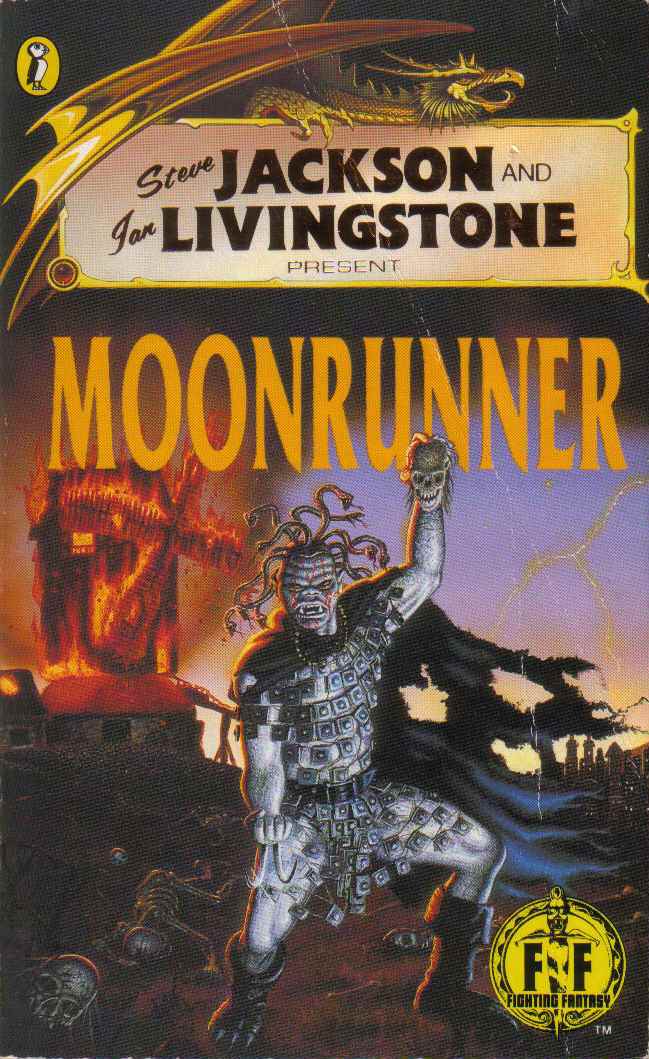
#48: Moonrunner


MOONRUNNER

Stephen Hand

Reviewed by Mark Lain

Often listed in fans’ Top 10 Best lists, Moonrunner has a formidable reputation as one of FF’s most accomplished gamebooks. The third (and final) FF from the very talented (and now somewhat reclusive) Stephen Hand, Moonrunner is a follow-up (not a sequel) to the extremely impressive #44 Legend Of The Shadow Warriors and continues the themes of the immediate aftermath of the Wars of the Four Kingdoms. YOU are not the same veteran as YOU were in the previous book though as your mission this time is rather more personal and you are seeking to bring to justice the unusually unluridly-named (for FF) Karam Gruul. Indeed, you play the part of a Bounty Hunter who, as this is a vengeance quest, eschews the usual motive of huge amounts of gold in favour of just getting closure. That’s not all, however, as there is more to your beef with Gruul (snigger) than just disapproval of his behaviour in the wars, but it is not until the end that the real meaning of the title becomes apparent.

Already, it should be evident that, by FF standards, this book is big on plot and the focus is very much on story and characterisation rather than killing things and collecting items (although equipment can be key to your success, all the same). From the outset everyone you meet is a well-developed character rather than the usual one-dimensional sword fodder, even down to potential throwaways like Orc Guards who have their own vernacular and ignorant way of speaking. Every NPC is fleshed-out, be it the way they speak, their obvious personality traits, some foible or other, etc etc, and you really do feel that you are dealing with “real” characters that have an identity and motive. Equally, almost everyone is out for themselves and you quickly learn to trust no-one unless they prove themselves to be worthy of your trust. And that’s one of the big aspects of this book: the way the atmosphere of paranoia and suspicion is maintained from the very first to the very last word that you read, which makes the setting (primarily the town of Blackhaven) one of the most oppressive locales in any FF book. Blackhaven itself is described in the Introduction as “a place so dangerous that the City Guards have to go around in groups of ten” so does that make it trump even the legendary Port Blacksand or FF’s other famously lethal celebrated setting, Kharé? I guess it does if it warrants that description! I will always be the first to say that Port Blacksand is FF’s best-designed settlement ever and, whilst Blackhaven (in terms of how much you can visit) seems to be smaller and less varied in its scope, it definitely gives PB some competition in terms of the sheer imagination that has gone into designing it and the over-riding theme of gothic horror prevails throughout. It’s hard to name my favourite part of Blackhaven as almost every cameo and area is brilliantly executed, but I do have a soft spot for the Rohmer Theatre (I happen to like The Phantom Of The Opera concept), Craven Asylum (as I like Lovecraft/Batman-type loony bin tropes), Gustav Hollmann’s wax museum (the Chamber Of Horrors at Wookey Hole will always be with me), and the mind-bendingly-named Last Octopus inn. That said, there is not one part of what you can visit/see in Blackhaven that isn’t exciting, unsettling and hugely imaginative. Even though the bulk of this adventure restricts you to an exploration of Blackhaven, it really doesn’t matter as you will want for more, and every playthrough will reveal something new as you unravel (and fall foul of) its lethal locations.

But the locations are far from the only thing that is out to get you in this book, as certain characters will haunt and torment you to the very end if you happen across them. First and foremost is the oft-mentioned Conrad the Maniac Guard (with a name like that you can’t help but be worried!) who will endlessly pursue and harass you right to the finale if you make the mistake of crossing him and, as his cameo occurs very early in the game, he will become a serious thorn in your side. Oh, and did I mention that he’s indestructible? Right, yes, he’s indestructible, so you really do need to keep out of his way if you can as you have enough to contend with without his interference too! Another, more subtle, endless tormentor that you can get tangled up with is Baron Milescu the Vampire. His mechanic comes in the form of a phial of his blood that you carry with you. The blood gives you a combat advantage but the pay-off is that, after EVERY combat, you must check to see if the phial has broken. If it has the Baron will appear and then you are in trouble! Not only are NPCs an Achilles Heel though, as many items you can collect are also a mixed blessing. In particular, the Skull of Mora Tao can be a key item to success, but it is also a massive nuisance. Basically, it feeds on the holder’s spirit in return for staving off mortality. Certain activities will arouse it and, if you don’t feed it a Skill point each time it gets hungry, it will grass you up to the “authorities” wherever you are and whatever you are trying to do. It is worth mentioning something at this point which these features raise and that is the amount of wry black humour in this book. The Skull’s behaviour is particularly amusing, but this book is riddled with little moments of gallows humour. Take the applications of the Disguise Special Skill for example, which has you dressing up as Orcs and vampires, amongst other things, repleat with plastic novelty fangs etc, or the inclusion of a boasting gobshite (who has seen and done everything) that accompanies you on the tour of the wax museum. Similarly, there are moments that seem to almost be digs at the accepted norm of fantasy gaming, and FF in particular. For example, the Introduction (which, as we have already seen, fires a shot across the bows of the big name cities in FF) justifies an equipment selection as “not for you the cumbersome leather armour so beloved of amateurs”. Nice. I have to mention another line in the Introduction which could be Hand even going as far as to parody himself with the comment ”It is the dead of night”…

We have mentioned the gothic horror theme throughout this book and this, along with the wry humour, amplifies itself in the sheer number of classic horror movie references that are there to be discovered and enjoyed by those who want to find them. This book is a veritable celebration of the genre and Universal Pictures’ 1930s/40s horror cycle in particular. The list of horror movie-related easter eggs is pretty exhaustive, but the ones I picked out are: Matra Ouspenskaya who is incarcerated in Craven Asylum = Maria Ouspenskaya who always played the gypsy roles in Universal horrors; Lugosh who is holed up in Priestsgate is one letter away from (Bela) Lugosi; (Wes) Craven Asylum, along with the character of the Shocker (which was a Wes Craven movie title); The grave robbers Kilmarney and Hoggy: grave robbers open the 1931 Frankenstein movie, plus the illustration gives them a striking resemblance to Vincent Price and Peter Lorre; also they are later described as “fearless vampire hunters” (Polanski’s Fearless Vampire Killers perhaps?); The whole idea of the Wax Museum requires no explanation!; The Rohmer Theatre and its organ-playing phantom; The return of Doctor Kauderwelsch as a reanimated assemblage of body parts in the company of Son Of Kauderwelsch ie Son Of Frankenstein; You can jump/fall down a windmill blade at Weathern Mill à la Victor Frankenstein in the climax of the 1931 Frankenstein; The machete-wielding Conrad the Maniac Guard who just won’t stay dead no matter how many times and different ways you kill him (including drowning and burning) is clearly Jason Voorhees from Friday The 13th (and he even looks like him in the illustration, right down to the hockey mask!) The list goes on…

Whilst the horror movie influence is almost impossible not to notice, I don’t personally see this book as a horror genre piece in the same way that #10 House of Hell or Keith Martin’s two Count Heydrich books are out-and-out horror. Some may disagree but I say this because the quest, the item/info hunting, and the underlying generic approach of exploring the city and then heading towards your final destiny is very much traditional medieval fantasy rather than archetypal horror. Yes, some characters are straight out of horror, but you need to be familiar with their sources to realise this, otherwise this book is not horror in the totally explicit way that HoH or the Heydrich books are. The system and mechanics of this book add credence to this argument: you start with a sword, backpack, etc and 2D6+12 Gold Pieces – all very conventional medieval fantasy launch points. You also select four Special Skills from a list of nine which have no horror concepts in them and are all very conventional fantasy talents. In fact, the list of Special Skills would not be out of place in a skills-driven book like #29 Midnight Rogue and there is a definite link in this respect. Add to this your five starting Provisions and a special (very realistic and welcome) rule about a -1 Skill penalty for fighting hand-to-hand, and you get the foundation of something very standard, fantasy genre-wise. The only “given” missing is a starting Potion, but FF had mostly eliminated this by this stage in the series. Hand’s own Legend Of The Shadow Warriors used more realistic rules incorporating Armour adjustors (which I really liked) but I’m not sure that this level of nuance was really necessary for Moonrunner as it is the plot development that we are expected to focus on above anything else.

Initially, it seems that your main aim is to gather information and you start out finding some leads very quickly. However, the book is sly in this respect as your opening leads are deadly red herrings (one causes the recurring Conrad nightmare) and, in a neat twist, if you hunt around too long and find too much intelligence, Gruul will be onto you and progress will quickly become very difficult. The underlying function of Gruul’s always being one step ahead is controlled by code words, as are the consequences of certain actions when dealing with NPCs. I am not usually a fan of code words in gamebooks but here they seem un-intrusive and really do make the cause-and-effect flow well, especially as they usually lead to entertaining moments rather than driving the adventure excessively as is the case in some gamebooks that use code words. Interestingly, other than you being frequently penalised for drawing too much attention to yourself, Gruul himself is a slow burn and seems very shadowy and intangible in the early stages. Normally FF lays the big baddie on thick from the get-go, but here you have to slowly uncover him as you go along. That said, and in a brilliant bit of plotting, his influence is everywhere and he is always on the front foot which just adds to the oppressive atmosphere and your feeling that everyone is out to get you (and most of them are as Gruul’s stranglehold on the region is pretty comprehensive!)

The Special Skills mechanism has a huge influence on how your adventure pans out and your choice of Skills is at the core of the gaming experience you will have. There is no optimum combination as such (I hate it when you can fail a gamebook before you’ve even started just by choosing the wrong selection), although some combinations can make things easier or harder than others. The Special Skills are checked and used very regularly and are the central function in this gamebook’s design as the book has multiple paths to success based on what Skills you have. Equally, this book can be completed with rock bottom stats (a rare and welcome thing in FF), assuming you have the complementary Skills to get you through and/or tread carefully. Obviously, avoiding certain perilous areas can lower the reliance on Skills and Luck Tests can be substituted (at times), but you will very quickly have a Luck score of zero if you rely on this as your only gambit and might even end up dying quickly especially as some Luck tests are critical. Skill tests are also liberally scattered throughout and, in a neat twist, passing them can get you into worse situations (or even kill you) as succeeding at a manoeuvre might not be the ideal outcome. There are also a few 3D6 Stamina tests at particularly crucial points so maintaining a decent Stamina score by using experience of previous attempts at the book and eating at the right times is wise. Indeed, this book is riddled with -2 Stamina penalties, particularly when trying to acquire key items. However, there is no way you will be able to collect EVERY key item and suffer every Stamina penalty as the Skills-driven plot elements, as well as certain time limits (in the very Skills-influenced Harbour Row section, for example, some parts of which can be very time-consuming) and impossible path combinations, prevent this from being a serious problem. The obvious point to make at this stage is that this book is totally non-linear with multiple paths through, many of which are mutually exclusive, which makes the replay possibilities endless as you cannot possibly visit everywhere in one playthrough, and, trust me, with the wealth of consistently excellent material on offer here, you will want to revisit this book over and over again.

The factors we have just discussed might suggest that this book is rather difficult and it is certainly a challenge to complete it regardless of the route, but this is more down to you needing to map out and unravel the book which means you need your head screwed on, rather than the book being weighted against you in any traditional sense. The Special Skill driver is consistently deployed and does not seem to be out to scupper you at every turn, and the Stamina penalties will not mount up as much as it seems if you just flick through and tally up how many there are (as you don’t need to, and can’t, suffer them all in one single play). Various perils are avoidable if you know how to avoid them (Conrad in particular) and treat NPCs with a certain amount of dignity and respect (shopkeepers, for example) and even the really big infested areas full of kill points (eg: Penkhull and its Fogwalker blight where you have a one in six chance of insta-death after every combat) are not essential to visit on some paths. (And even the Fogwalkers can be nullified with a certain Special Skill). The difficulty or ease of your quest can be influenced by a function whereby you need to make important decisions about when and how to use certain items (the Wards in particular, all of which fiendishly have a penalty to you for using their advantageous properties) and, very unusually for FF, this book is very light on combat (again, because the focus is on plot and the use of your chosen Skills to find alternative paths to victory). What combat there is is generally fairly easy barring a few “Specials” that are as powerful as would be expected, which is very logical and fair. The final showdown with Gruul (the natura fight) will probably require you to still have some key items from the Harbour Row section but even this might not be the case. However, as this fight has you totally at the mercy of a dice roll it does seem a little arbitrary and the result can be deadly through the fault of no previous decisions you have made. That said, survive this part and the code words come back in force and, if you have caused too much trouble on the way, you will pay for your irresponsibility with failure at the final hurdle. The real trick to beating this book, and the reason I maintain that it is tricky and cunning rather than literally “difficult”, is in mapping (as I have said) and knowing how to almost respect its design. By this I mean that, at face value, you are generally free to roam and can visit areas in whatever order you wish (within the limits of time and your chosen/assigned path), even being able to revisit some areas, but the point is that you do not actually want to! Rather you need to identify which routes and areas go with which combinations of Skills and plot your path this way rather than trying to see everything and best everyone otherwise you will soon come unstuck. That is what I mean about respecting this book – it rewards careful close play and penalises gung ho killing and plunder, something which is rare in a gamebook. Therein lies the secret to just how cleverly designed this books really is and it is one of, if not the, most intelligent book in the FF series. Keith Martin’s FFs used this freeform RPG-style approach too, but in a less controlled and subtle fashion.

Impressive gamebook design is not everything though, as the writing needs to be compelling enough to justify the material. In this task, Hand excels and his prose is rich with atmosphere and texture to immerse you from the outset. And he never drops the ball at any point in what is a truly superb piece of gamebook writing, in the literal sense. He even plays with your mind’s eye in places and subverts your expectations: take the Last Octopus inn idea or the description of Mawn Pretoragus’ sanctum made up of “constantly shifting angles” – just try to actually visualise that. It makes sense as words, but does not make sense as an image: think MC Escher, but in text form. The perfect companion to Hand’s horror themes and sensibilities is Martin McKenna’s Hammer-influenced internal art. I cannot think of a better FF artist than McKenna to visualise Hand’s worlds and it is no surprise that McKenna illustrated all three of SH’s FF books. MM’s work here is as excellent as ever and he really captures the terror and mystery of what Hand throws at you. The cover by Terry Oakes is one of Oakes’ better efforts showing a scene of colourful carnage that just might be the back story to this piece, given how controlled the actual content of this book is.

The Universal horror influence on this book is clear, but there are also Lovecraftian tropes such as Craven Asylum and the very Lovecraftian Ectoplasmic Lurker (again, brilliantly drawn by McKenna in all its eldridge glory) that very generously restores your Stamina every time you wound it. More conventionally terrifying is the Shocker with its huge single eye (drawn almost hypnotically by McKenna), but there are also some very cleverly designed and unique encounters such as the Xen-Viper and the Obsidian Predator. Hand does not try to be too high brow and unique though and there is a place for some conventional fantasy species such as Orcs and suchlike – again, a brilliant bit of design that shows considerable thought in the planning of this book. We also cannot fail to mention that Hand favourite that debuted in Legend Of The Shadow Warriors, the Mandrakes, who are back (well, one of them is) in a genuinely unexpected cameo role (remember to use fire lol). This gives a nice link to the earlier book and the return of the Frankenstein-like Doctor Kauderwelsch is another welcome inclusion, along with some development of her character and update on her fate between the two books. A very subtle little linking inclusion too is the Shadow Warrior masks in the image of Kiennar’s Curiosity Shop. Very clever.

If I have any criticism, and they are fairly trivial niggles really, they would be that, to get the most out of this book you do need to have read/played Legend Of The Shadow Warriors or you will miss out on the inter-related material and the mandrake and Kauderwelsch bits might seem jarring and randomly inserted with no context behind them, and that, even at twice the length, I would not be able to get enough of this book. Yes, the limit of 400 sections keeps it taut and effective, but you cannot have enough of Blackhaven and its superb selection of incidents and experiences. On the subject of the 400 sections, it is noteworthy that paragraph 400 is not the victory section. Normally, FFs that subvert the “Turn to 400 and win” approach have multiple win endings but this one does not seem to go by that rule. Maybe it’s just hand going against the grain again or maybe we are expected to feel a hollow victory? It’s not a big issue, but it’s worth bringing up, I think.

The word “masterpiece” is used far too liberally in reviews, but I struggle to find a more suitable word to do Moonrunner justice. It is intelligent, well-designed, eminently replayable, the challenge is more cerebral than normal in gamebooks, and the emphasis on feeling the plot and the world of this book over simply slaughtering everything in sight and stealing items, makes it a hugely satisfying experience. The book grabs you and fuels your imagination from the very start and it is very hard to put it down as there is no let-up in its brilliance from one moment to the next. What Hand would have followed this with we can only guess, but, if this is a step towards something even greater, I can only assume that the planned but never produced Blood Of The Mandrakes would have been the greatest FF book ever, as Moonrunner is up there with the absolute best. Truly outstanding.

Tuesday, 26 February 2019

You Are The Hero Part 2


YOU ARE THE HERO PART 2

Jonathan Green

Reviewed by Mark Lain

When the second part of Jon Green’s definitive history of FF was announced eyebrows were raised as to exactly what content it would offer. The amount of new material that had appeared under the FF banner between the first volume’s release in 2014 and the second instalment’s announcement in 2017 was hardly going to fill a pamphlet, let alone another weighty book, but, in spite of the potential scarcity of content, YATH2 funded in under 24 hours on Kickstarter meaning fans had faith that this was going to be a worthwhile project either way. Mirroring the format and release gambit of the first YATH, YATH2 is a deluxe oversized coffee table book that was finally unveiled at Fighting Fantasy Fest 2 on 2nd September 2017.

The first thing that strikes you about this book is that it is rather thinner than YATH, clocking in at 90 pages shorter than the first book. The second thing that strikes you is that, on beginning to read it, in the first seven pages of text alone, the first YATH is name-checked six times and, after 10 pages the YATH-mentioning count has rocketed to 15 times! I’m not sure the first YATH needs quite this much plugging as I would imagine that most readers of the second Part will have read the first.

So, exactly how are the pages of Part 2 filled? The opening Chapter covers FF conventions and those in the know will quickly observe that there have been very few events dedicated solely to FF. In fact, there had been all of two up to the point this book was written: Fighting Fantasy Day in 1985, and Fighting Fantasy Fest in 2014. Is this really a Chapter’s-worth of events? It is not easy finding people who were at FF Day but one does get interviewed and, due to the limited amount of available information on that event, the 1985 gathering in Manchester gets just half a page of coverage. This is a shame as I’m sure most fans would appreciate more detail on this convention (well, I would anyway) which few of us were able to attend and which has largely been consigned to history. Its inclusion is definitely of interest as I doubt many people are even aware that it took place but a bit more research and information would have made this seem less like a starter course to whet our appetites for the rest of this Chapter which, in a heavy imbalance of content, offers us six pages about FFF in 2014. Admittedly the 2014 convention is in more recent memory, but this section goes into unnecessary depth in what is a blow-by-blow account that pushes the envelope in terms of valuable material and a point is already being stretched in content terms as soon as YATH2 begins.

Chapter 2, covering writers, looks more promising though as it begins by profiling Keith P Phillips in what is an adjunct offering material missing from the first YATH. Even though Phillips only wrote one FF book it is a highly-respected, if brain-meltingly hard, outing and it is interesting to get an insight into Phillips’ thought processes behind the book as well as submission practice at Puffin at the time. As Phillips is a lesser-known FF author it is nice to see him getting decent column space and his input is well worth reading. Second up is Kieran Fanning (who?) I’ve never heard of him but apparently he is a successful current children’s author so there is no real reason why I would have, to be honest. But, why is he even in here? He seems to be more interested in Choose Your Own Adventure and Way Of The Tiger than FF (yes, I know they are gamebooks, but this is the history of FF, right?) and he only makes mention of one FF book. Indeed, most of his interview is just him plugging his own fiction. Tenuous and of little value. Next we get Garth Nix, the man who wrote the science fiction short story Sam, Cars And The Cuckoo printed in Warlock #2. It is fascinating to have such an obscure contributor to FF history covered and it is good to see such depth being gone into to make sure everyone involved in FF history is included in the story, no matter how small a contribution they may have made. However, he literally says of his “brief association with FF”: “I’m not sure it has had any particular influence [on my career]”. Er, Ok, moving on then lol. Nix does tell us the story of the creation of his Warlock short subject though and focus on tiny details in FF history is always welcome. The remainder of Chapter 2 then proceeds to give an update (the first genuinely new “sequel” material in YATH2) on Arion Games’ latest AFF products (and there are plenty of them to cover) plus it provides information on the French iteration of AFF (Défis Fantastiques: le jeu de rôle) including a beautiful full-page colour image of a dragon by Malcolm Barter which is otherwise exclusive to the French AFF edition and in doing this YATH2 showcases an example of generally localised art to a wider audience, rather than all its full-page art plates just being familiar UK cover images, which would have been an easy (but less appealing to the hunter of surprise new material) win.

In a natural progression from a Chapter on authors, the next Chapter discusses artists. As with the previous Chapter, this section begins with another supplementary piece to the first YATH, this time profiling Geoff Senior. Sadly, this Senior coverage says very little of consequence other than a general potted career summary in five (somewhat short) paragraphs. We then get just over three pages about Stephen Player and I must admit to becoming concerned that, as he illustrated Green’s Stormslayer, this section might lurch into JG talking about himself which was a major gripe I had with the first YATH. Thankfully, this does not happen but, instead, the book heads off on a drastic tangent that goes into way too much depth about Player’s SFU Fantasy Art course students and their FF-based (or, more to the point, Stephen Player-based) artwork. I’m not convinced that this is of any real value other than to fill pages. That said, there are some impressive pieces in this section, especially Ron Monaoi’s full-page Yeti Attack which would not be out of place in Caverns Of The Snow Witch. Following on from some random art students, we get a section on aspiring FF-influenced artists, including the work of the excellent Alex Siddy whose digital Bloodbeast image and a very different, far more visceral and horror-filled monochrome alternate Temple Of Terror cover reimagining, are very impressive, and he is brave to successfully rethink the work of two of FF’s greatest artists (Iain McCaig and Chris Achilleos). He also contributes a nice Zagor/mountain illustration prepared especially for this book. Following this we get a brief comment on fans’ tattoos which is a nice inclusion, even if I doubt it really offers anything other than demonstrating fan obsession mixed with just how much FF imagery means to the fans. Finally, this Chapter concludes with Chris Achilleos talking us through the creative stages that produced his newly-commissioned YATH2 cover art. Whilst it is fascinating to see how a master works, the resultant cover is awful with its overuse of purple (for some reason) and its figures that have nothing of the brilliance that was a trademark of Achilleos’ art in the past. I honestly cannot believe that this is by the same artist who produced some of the greatest fantasy art of the ‘70s and ‘80s. Is the YATH2 cover his worst work ever? Probably, yes.

To continue the art theme, Chapter 4 looks at that staple of fantasy gaming, mini figures. Covering the rarely-seen range of plastic FF minis is a good inclusion and could prompt collecting opportunities for those who are not aware of this range’s existence (assembling a complete set is a major achievement as these figures are very rare) and we even get an interview with their sculptor. Next comes a few sentences on the six generic plastic minis that came with the WOFM boardgame, followed by two slightly longer paragraphs about the Legend Of Zagor boardgame figures (admittedly there are a whole lot more of them!) which do at least include four recognised FF player characters and the Zagor Demon himself, rather than just being six random fantasy figures as with the WOFM minis. I feel obliged to mention that my Scriptarium Yaztromo mini is also included here and I’m pleased to see this as it gives a spotlight to the very talented Steven Leicester’s figure painting skills. A really fascinating inclusion in this Chapter is an actual photograph of the near-legendary FF Battlegame 3D dungeon pieces – surely a collecting Holy Grail for even the most hardcore collector. A necessary inclusion is a section on the creation of Otherworld Miniatures’ white metal Zagor figure (of FFF fame) and we get thorough coverage of the design and development that went into producing this item. Sticking with the “FFF minis” theme, next up are the yet to commercially materialise, but very impressive, Pure Evil Miniatures range of resin figures that were seen in tantalising prototype form at FFF. The entire range is pictured, including some previously unseen minis based on monsters from The Port Of Peril. This gives hope that there is still activity in the range and that we may still see these on sale one day. From official figures, we then move into the world of fandom modelling and this section is a real revelation. It’s not often considered that fan art is anything other than traditional drawing and painting, but the showcasing of talented fans’ modelling work (mostly scratch-built which is a skill that I envy) is a really good inclusion. Amongst the fantastic work on display is a stunning paintjob on a mini perfectly recreating the complex John Blanche colouring on the Slime Eater from the cover of Khare, as well as Johan Tieldow’s highly original Zanbar Bone PEZ dispenser! Indeed, Johan has created a whole series of clay sculptures and drawings of Zanbar and those included here are just the tip of the iceberg of another very talented FF fan artist’s work.

Moving on from visual art, Chapter 5 covers the rather less obvious subject of FF-influenced music, something I would imagine is news to most FF fans. In reality, this Chapter shows FF’s influences on obscure unsigned and/or self-releasing bands, plus Steve Jackson’s occasionally-performing R&B covers outfit (of which there are many video clips on YouTube). No-one massively famous then, but this is a very off-the-wall topic to include and shows an out-of-the-box thinking in the way this book has been put together. Also featured are the composers of the soundtracks to Tin Man and inkle’s FF apps, coverage of which is as thorough as is needed for such a peripheral subject.

Whilst the first five Chapters of YATH2 cover a good variety of FF-related areas and are certainly worth reading (if only once in many cases), the actual amount of focussed material is rather sparse. In saying this, I mean that the bulk of the subject matter is either fandom or random stuff that would otherwise be ignorable and would be unlikely to have made the cut for the first YATH (eg: app soundtrack composers, authors who might have vague memories of having once have read a FF book, etc), even stretching the point to 3rd parties influenced by art courses taught by a FF artist. Yes, it’s all FF-influenced but how far can you pull the connecting threads before they become so thinly-stretched that they break and all we are left with is the sound of the bottom of an already thoroughly-scoured barrel being scraped? Much of this just seems to almost be ads for interested parties’ work.

If you have stuck with the rather inconsistent programme for the first five Chapters you are then in for what seems to be a much more relevant sixth Chapter all about Fighting Fantazine, the by all intents and purposes official fanzine and successor (in content, style and presentation) to Warlock magazine. This section seems much more worthwhile than the previous five (bar the useful Keith Phillips appendix) and means that 74 pages into YATH2 we are finally getting material worthy of the first YATH volume. The whole history of the ‘zine is covered, including interviews with all the major protagonists, a lengthy section giving insight into how the selection and refining of the all-important mini-FF that each issue features functions, and finally a critical discussion of the ‘zine’s main editors’ views on the best of the bunch of those mini-FFs. I found it quite amusing that there is a brief teaser nod to my own contribution (Sister Angela’s Veil) that had just gone through the finalisation process for inclusion in the then-imminent issue number 16. This chapter is thus far the most focussed and relevant by a long way and does not suffer the problems that the previous Chapters did whereby you are sifting through general fandom bumpf trying to pick out a few gems of chronicle-worthy content.

After a strong Chapter 6 we get what is effectively a Kickstarter contractual obligation covering collectors. The two big guns are profiled (Jamie Fry and Steven Dean) and we get to see and hear about some juicy titbits of their collections, as well as Jamie Fry’s essential, meticulously-researched and exhaustive work that is the FF Collector’s Guide getting mentioned. In a similar vein, the well-known FF art collector Pat Robinson shows us his spectacular and authoritative collection of cover art originals (his hallway walls are to die for) and the full-page rendering of Terry Oakes’ wonderful cover from The Rings Of Kether is a glorious inclusion. The fourth and final collector we hear from is the less-known Teofilo Hurtado who gives us a welcome overview of the Spanish FF market, although quite why he submitted such an awkward-looking photo of himself I have no idea! Incidentally, to get a full-page profile of you and your collection in YATH2 required you to back at a whopping £500 level. Was it worth it? I guess they must have thought so but you could get some fantastically-rare items for your collection with that kind of money. This Chapter is surely just a vanity piece for the four contributors and is of rather less interest to anyone who is not them, even if there are some lesser-known rarities mentioned. Kickstarter obligation aside, this Chapter can pretty much be ignored bar the big Kether cover image.

A dramatic change in relevance comes with Chapter 8. This Chapter is much more substantial in terms of content and thoroughness than any preceding it, discussing as it does video game and app adaptations. The first YATH documented all of the computer/video game releases from the 1980s ZX Spectrum/CBM64/BBC/Amstrad through to the early 2000s versions, but this Chapter offers an actual update and is only the second of these in YATH2 (after the AFF update roundup in Chapter 2). Coverage of inkle’s huge and sprawling Sorcery apps is very long and in considerable depth, followed by an equally if not even more thorough look at Tin Man’s sublime Windows version of WOFM. What follows is an unexpected look at Dave Sharrock’s labour of love Minecraft recreation of Allansia (the existence of which has to be news to most of us) and then comes similarly in-depth discussion of Nomad Games’ fun diversion that is FF Legends. The only weak part of this Chapter is the final brief section on how other game designs may have been influenced by FF which seems to be an unnecessary tagged-on piece more in the style of earlier Chapters’ vaguely relevant material. Otherwise this is the best Chapter yet by far in terms of true relevance.

Indeed, YATH2 remains on track with the next rather longer Chapter detailing comic books and graphic novels. We all loved Lew Stringer’s Derek The Troll from Warlock (and later White Dwarf) magazine and this character is up for discussion first, primarily through the recent collected single volume GN that Stringer published. Andi Ewington’s excellent Freeway Fighter comic series then follows including a fascinating insight into everyone involved’s creative processes from the obvious ones of author and artist through to the less generally familiar role of Titan Comics’ commissioning editor. There is even an appropriate tribute to the late Kevin Bulmer who drew the internal art for the original source gamebook. This section does contain a few spoilers (especially where the comic sits in the timeline compared to the gamebook) but this hardly matters and does not detract from an excellent bit of coverage. It is great to see all of the cover variants for all four issues in one place (this is also handy for working out if you are missing any) although I’m not convinced that four paragraphs should have been given over to an online review as this is not really of much use as it goes against the objective chronicle approach of the YATH books. The third part of Chapter 9 is inevitably dedicated to the controversial and somewhat lacklustre The Trolltooth Wars GN. Again, coverage is very thorough, especially of the creative processes involved as well as the sheer logistics of attempting an indie project like this without the support of a publisher, and I’m very pleased that Green interrogates the ridiculously long delay issue which soured this project for so many Kickstarter backers. The reasons given by PJ Montgomery make sense, it’s just a shame we never got given this explanation during the KS campaign. I would have liked to have seen a balance in the number of full-page plates from both Freeway Fighter and The Trolltooth Wars in this Chapter as the inferior Trolltooth Wars artwork gets rather more page-space than the much better Simon Coleby art from Freeway Fighter, but that is just my own taste. As someone who has been reading comic books for almost as long as I have gamebooks, this Chapter is very worthwhile and quite fascinating regardless of my personal views of the actual comics in question. The Trolltooth Wars Kickstarter fiasco needed documenting and it is done very well and not to the detriment of also covering the artistic and practical aspects. Avoiding the KS subject would have seemed like a cop-out, but focussing on that alone would have been unfair and unbalanced. Freeway Fighter was far easier to document as there are no metaphorical clouds over its development. If anything, Chapter 9 trumps Chapter 8 for me in terms of its quality, but that is just because I am more interested in comics than in video games.

Chapter 10 is odd. It is not immediately obvious how television and FF could be connected enough to warrant an entire Chapter being dedicated to this subject and I find this section to be clutching at straws for content. Many fans are aware that WOFM was profiled on The Book Tower in the early-‘80s (the footage is possibly lost from the archives due to junking if I understand correctly) and this program gets only a short paragraph by definition as few can have seen this clip, or will recall it in much detail, if they have. There is a very tenuous Ben Elton section mostly about D&D (the only proper FF association being when Elton plays The Forest Of Doom on-screen at one point), but the next section covering the BBC’s highly imaginative Skill, Stamina And Luck interactive documentary from a few years ago is much more relevant and I’m glad that this brilliant creation is not forgotten. Sadly, the rest of this Chapter is of little real value as we get told about a FF question (literally just one question!)  that appeared on the excruciating quiz show Only Connect and a Brazilian chat show that Ian Livingstone was invited to appear on. I do wonder whether YATH3 will feature the brief snippet from 24 Hours In A&E last year where a patient is playing Stormslayer for a few seconds in a Waiting Room? Given the threadbare material in this Chapter I suspect it probably will qualify for the next book!

Moving swiftly on from the pointless Chapter 10, Chapter 11 gives the necessary update to the previous book’s update (ahem) on Jackson and Livingstone’s post-FF activities including the little-known Sorcery-themed cocktails that were served at inkle’s Sorcery 4 launch party (another nice obscure detail worth documenting). As he tends to be more obviously active, Livingstone gets the balance of coverage and I am particularly struck by the sheer passion he expresses in his interview here regarding the educational prospects and potential of video games. There is a nice long spotlight on recent convention activity in Brazil (perhaps that’s why the previous Chapter randomly included the Brazilian chat show bit then?) including a particularly important section about the Daielyn Cris custom City Of Thieves design project that she presented to IL. This obviously led to the disastrous Indiegogo campaign to fund a grossly-overpriced and rather ludicrously over-engineered special edition deluxe hardback City Of Thieves but this definitely needed including in YATH2 (and I’m glad it was) as no FF fan is likely to forget that laughing-stock in a hurry!

Obviously, the story of what FF’s two creators did next would be incomplete without documenting the new Scholastic printings and Chapter 12 is given over to this subject. There is a wealth of useful information in this Chapter including the shortlist of titles for what would eventually see the light of day as The Port Of Peril as well as it being pleasing to me personally to see James Aukett’s Beer-O events get mentioned as they are popular gatherings and he puts a lot of work into planning them. And why are they mentioned? Because it was at one of these that the discussion was had about what title that book should be given. The ins-and-outs of how the Scholastic deal came about are covered and The Port Of Peril is inevitably the centre-piece to this subject, including the (accidental) naming of the guilty party who clearly failed to do a decent job of playtesting it (in fact, it is retrospectively quite hilarious how much credence this person appears to put into being thorough in editing these books!) For anyone who hadn’t already noticed it, the Salamonis typo on the new Leo Hartas Allansia map is noted too. As YATH2 has not shied away from controversial subjects (The Trolltooth Wars GN delay, the uber-deluxe City Of Thieves debacle) there was no question of the emotive topic of the new art coming up and, again, this is sensitively treated when it could so easily have become sensationalist. In brief, fan reaction and Scholastic’s justification are both discussed as needed. New cover artist Robert Ball gets his say on the concept and thinking behind the new covers and we get a full-page plate of the alternate proposed cover for The Port Of Peril which I personally prefer as it contains much more horror but it was probably too scary for today’s pc brigade to approve. This Chapter also covers the most polemic subject of all and the one everyone quickly raises when the Scholastic series is mentioned and that is Vlado Krizan’s incompetent internal art. Abomination that Krizan’s art is, this time, and probably wisely, Green avoids the backlash bloodbath that it got from the fanbase and this section is mercifully brief being just a quick analysis of how Krizan worked on his pieces. Finally, it is hinted at that Jackson might be convinced to write another FF and we get his explanation of why he suddenly stepped away from writing FF books the first time around. Again, this is useful historical detail.

YATH2 is a companion piece, not a sequel to the first book. Yes, there are necessary updates, but this is more of a book about fandom activity than the first, which was very much an in-depth chronicle of FF and its creators. The two books complement each other well in this sense but YATH2 is much more of a niche piece, barring the sections that give genuine updates to the FF story. It is certainly rather less essential than YATH unless fandom really interests you. It is also rather shorter and sparser on actual valid content as opposed to discussing sometimes irrelevant people who admit to not really being influenced by FF but seem to have been included anyway. Green writes in his easily accessible journalistic style as before and this book can be read through in one or two sittings with no problems. The irritating tendency Green had in the first YATH to draw the narrative round to himself as much as possible is noticeably (and mercifully) absent this time around and he has clearly responded to readers’ reaction. As with the first book, the main text is punctuated by boxes containing FF trivia which are often fascinating to read. It is good too that supplementary material missing from the first books is added (Phillips, Senior) to continue the thoroughness of approach. If I have one major criticism it would be (other than the semi-relevant nature of much of what is discussed) that this book is riddled with typos and grammatical errors and some sentences are awkward or make little sense as a result. For example we are told that we are getting “insightful, riveting insights” (I’d be surprised to read an insight lacking in insght!) and the comment in the section about FFF that tells us that “Steven Dean going away with not the … Deathtrap Dungeon swords” is gibberish. An interesting undercurrent that runs throughout this book is the way that Russ Nicholson, Iain McCaig and John Blanche are clearly considered by anyone who expresses a view on the subject to be peoples’ favourite FF artists (I’d cite the first two, but would also add Alan Langford and Martin McKenna for internal work, Gary Mayes for sci-fi, and Chris Achilleos for covers) and I’m surprised that Achilleos is not up there in the FF consciousness in the same way. Perhaps it was because he was responsible for the terrible cover on this book? Unappealing cover aside, there is some essential information within (especially the updates), but the amount of fandom filler does become a minefield for the reader to navigate whilst not letting this overshadow the genuinely excellent sections that this book has in parts. Overall, this is a very mixed bag and the first YATH was miles better.

Wednesday, 6 February 2019

Steve Jackson's The Trolltooth Wars


STEVE JACKSON’S THE TROLLTOOTH WARS

PJ Montgomery and Gavin Mitchell

Reviewed by Mark Lain

Mention this graphic novel adaptation of Steve Jackson’s 1989 book of the same name to most FF fans who were involved in the funding and they are far more likely to talk about the shambolic Kickstarter campaign that led to its creation than the GN itself. Mention it to anyone who did not support the Kickstarter and they will probably look at you blankly and start Googling how to buy a copy. We will discuss the thorny subject of the Kickstarter later, but the apparent lack of awareness of the GN beyond that project has made it something of an obscurity in the fan community, a problem which is not helped by the relative lack of distribution outlets where it can be purchased - as a privately-published title it’s essentially only available from its own Bigcartel website, anyone who backed the KS at the retail levels (which amounts to all of ONE backer who pledged for 10 copies), plus I’ve seen it in Travelling Man in Leeds…. Oh, and, several of the KS backers sold their copies peer-to-peer fairly quickly so not even all the backers have a copy anymore. A year after its Summer 2017 release, it would be further overshadowed by the far better-promoted (and distributed) Freeway Fighter comic book published by Titan Comics (which was also better-received as it didn’t overrun its original release schedule by 18 months like The Trolltooth Wars did!)

So, was it worth waiting all that extra time for? Firstly, let’s get something clear: I love the original novel. Granted, it isn’t as dark and brooding as its superior sequel Demonstealer, but it is so bursting with exactly what FF fans want (ie lots of FF exploitation) that it’s hard not to find the source book thoroughly enjoyable. The fact that it brings four popular FF NPCs all together in one place (Zagor, Balthus Dire, Zharradan Marr, and Yaztromo) adds to the appeal, plus the original novel is jam-packed with FF lore and background detail, including the clarification of a few logic question marks that you find yourself pondering over after playing some of the earlier books (especially The Warlock Of Firetop Mountain and The Citadel Of Chaos). There is a lot going on in the source book and it is by necessity fast-paced as it switches the action between Balthus and Zharradan’s machinations and plans for war, battle scenes/massacres, and Chadda Darkmane’s adventures from Salamonis to the Galleykeep via Yaztromo’s tower and Firetop Mountain. Jackson’s book is quite cinematic in its approach and Montgomery’s GN tries to emulate this with frequent scene shifts, often from one page to the next, which can make it seem a bit all over the place (especially if you aren’t familiar with the Jackson novel). For this reason, you do have to concentrate on the headers that sometimes set the location and/or rely on the illustrations to give you an idea of where any particular page of action is taking place, or maybe even use the characters as the only way to keep up. In places this is executed well, especially one particular page where we see Balthus and Zharradan plotting similar things, one on the left of the page, the other on the right, leading to them both announcing the same thing in the final plate. In other places, it just gets muddled and you find yourself referring back to the Jackson novel to untangle what is going on. Don’t get me wrong, by no means is the GN complicated, the problem lies in the necessity of adapting a novel into a GN as huge amounts of scene-setting text in a novel can be condensed down to one single image in a GN. Indeed, entire chapters of the Jackson novel are often reduced down to just one or two pages of this GN which is why it seems to flit about between people and places so much. Essentially, all the core plot from the novel is there, it’s mainly the asides and little cameos from the book that are missing from the GN (eg: the elf fight in the Fatted Pig, Calorne Manitus’ explanation of why Shazaar is so bizarre, etc), but curiously Chadda Darkmane’s key motivation is also entirely excised, that being the concept of Amanour. In the original novel, Darkmane is out for himself and agrees to take on King Salamon’s commission so as to increase his Amanour (ie kudos), whereas in the GN he comes across as rather more honourable as he accepts the mission purely for the honour of serving his King. These two things are very different. In the novel Darkmane often seems self-possessed and driven by Amanour to the point of being quite obnoxious, whereas the GN presents him as a far more courtly hero in the classic sense. This does create a very different feel to the piece and makes you rather more sympathetic towards Darkmane and makes you be more forgiving about his attitude towards things like sorcery and the Cherva’s obsessive vegetarianism than you are when reading the novel, but it also makes him seem like a bit of a goody-goody wuss. Given that Darkmane is the YOU of the piece though, I do wonder why he accepted the mission in the GN version – there is no apparent reward of any kind (not even money), so why root for him? Actually, Balthus or Zharradan seems far more worthy of the reader’s support in the GN version, especially Balthus who is the underdog for much of the story (as he is in the Jackson novel) and who isn’t presented as especially evil in the GN. Zharradan is clearly the bad guy in this version. Even Zagor seems more sympathetic and easy to get on-side this time around, whereas in the novel he is still basically psychotic.

A key part of the source book is the wealth of lore presented in long contextual asides. Almost all of this is missing from the GN, bar that which is totally essential to following the basic plot ie the link between the Demonic Three and Volgera Darkstorm, and Marr’s background with the women of Dree. Interestingly, this latter item is actually lifted from Creature Of Havoc, rather than The Trolltooth Wars, but it greatly helps us to understand Marr as a character as well as how mharranga fits into the plot (even if its use is muddied in the GN and amounts to a handful of plates again). The same happens when Balthus takes his two cunnelwort trips – in the novel this is fully explained whereas in the GN it is, again, reduced to a handful of plates and makes rather less sense. I would imagine that, without being familiar with the original novel, all of the cunnelwort/Sorq/Ganjee plot elements would be missed and/or confusing if you only read the GN and, as cunnelwort is the primary plot maguffin and the cause of the titular wars, this is a massive issue.

So, with Amanour completely removed and cunnelwort reduced to playing a bit part, what is left of any substance in the GN version? The answer is the build up to and skirmishes of the Trolltooth Wars themselves, and Darkmane’s mission to try to manipulate the wars to avoid Salamonis being swallowed-up by them (in other words, the action). Yes, these are huge parts of the original novel, but the subtleties and the real underlying plot drivers are all missing from the GN, thus presenting the story as basically a territory war with a concerned bystander. As a plot summary, the GN is fine, especially if you haven’t read the original book (think film adaptation vs source book and you have the right idea), but as an adaptation I’m not convinced that the GN really offers much. The reason the subsequent Freeway Fighter GN seemed to work better was that it was new material rather than a reduction to the bare bones of existing material, which is where The Trolltooth Wars GN falls down. Admittedly, it makes for a fast-moving and tight GN, but then the source book is also tight and fast-moving, but still manages to offer far more in terms of lore and colourful expansion.

I do find myself wondering what, other than distilling and summarising the plot, Montgomery actually did when he put this together. Rather handily, the answer is in the supplementary material in the back of the GN, where he explains what goes into adapting a novel into a graphic novel. This is an interesting insight into the process involved and does help explain why so much of the book was excised for those who aren’t regular readers of the GN medium. However, I have read many novel-based GNs that do manage to incorporate all the background in one way or another so it’s a shame this could not have somehow happened with Montgomery’s version, notwithstanding the restrictions of time, art budget, and the practicality of having a two-inch thick GN as the finished product. On the subject of size, it has to be said that I was surprised to see just how small the finished GN is. Most trade paperback GNs are roughly A4-sized, but The Trolltooth Wars is closer to oversized A5 and is disappointingly small. The art plates are not in any way reduced though which is good to see, instead the overall effect is less impactful than it could have been had it been larger format, and we lose a whole load of textual substance.

The subject of Gavin Mitchell’s art is probably an even bigger issue than Montgomery’s plot distillation. The best comparison I can come up with is that Mitchell’s art looks like it is straight out of a Cartoon Network animation (The Clone Wars in particular springs to mind) and I really hate CN-style art with its elongated human forms and eggtimer-shaped heads with clothes made up of angular shapes that don’t look anything like as organic as they should. Russ Nicholson drew the internal art for the original Chadda Darkmane novels and, to my eye, it was perfect: his Chadda Darkmane is rough-looking and holds himself in a suitably cock-sure manner; Balthus is as he was in The Citadel Of Chaos – dark and sinister yet obviously human; Zagor is the Zagor from WOFM – tall, macabre, and literally crackling with sorcerous energy; the sorq are bizarre and electrical, whilst the ganjees are terrifying disjointed heads… the list goes on. Sadly, Mitchell’s art does not come anywhere near Nicholson’s interpretations: Chadda is far less grizzled and is almost cheerful-looking; Balthus and Marr look like the overly-chiseled victims of too much plastic surgery whilst having the sunken dead eyes of a chronic crack user; Zagor looks manic in old man form and is just the purple version of Balthus and Marr in true form (indeed, Mitchell’s Marr is just his Balthus but in green and with pointy ears); the sorq look like aerodactyl from Pokemon and the ganjees just look risible… basically, Mitchell’s art, for the most part, trivialises the tone of the piece and makes every character (human or monster) look cute and cartoonish. The worst portrayal by far though for me is that of Jamut Mantrapper – he is supposed to be a shifty sword for hire but Mitchell’s version looks like a happy-go-lucky Walter Raleigh-esque dandy. To avoid this being a complete hatchet job of Mitchell’s art, his landscapes, buildings, and cityscapes are actually very well rendered: the Dark Tower is suitably sinister in silhouette, Salamonis is the pretty utopia I always thought it should be (pre-Gates Of Death murder labyrinth, that is), and he draws day and night scenes very effectively. It’s a shame then that his character illustrations are so awful. In fact, some of his character drawings have genuinely bizarre inclusions. For example, why does the dead Sea Ogre need to have pubes (also, is it supposed to be female)? And, why does every human have excessively-pronounced cheek bones that make it look like they have two-storey faces? I can only imagine just how much better this would all have looked had Russ Nicholson illustrated this GN instead.

As is often the case in GNs, the eagle-eyed will spot several easter eggs drawn into the illustrations and there is some fun to be had searching for these here (which also draws your eyes away from the crappy human images and gives you a reason to revisit the GN once you’ve read it). It is nice to see that Balthus Dire has Emmanuel’s original CoC cover art on his study wall, and Zagor has the map of his Firetop Mountain dungeon domain on his study wall too. Moreover though, Yaztromo’s study is an absolute Aladdin’s Cave of easter eggs including the small tree in glass dome that the Cherva fiddles with in the source book (although this cameo is not in the GN), a price list featuring a Net of Entanglement and Armband of Strength (from The Forest Of Doom), the Deathtrap Dungeon video game skull logo in a mirror, and, more bizarrely, the Great A’Tuin from Discworld is hanging from the ceiling for some reason. I may be stretching a point here but I’m pretty sure that Prince Vultan of the Birdmen (“Gordon’s Alive!”) from Flash Gordon is sat at a table in the Fatted Pig, as is at least one of the Kickstarter backers who were willing to fork out a minimum of £400 to be drawn into the book (I believe seven backers should be in there somewhere, if the number of backers at the relevant levels is any indication). I’m sure there are other visual easter eggs that I haven’t found too, but these are just the ones I’ve noticed.

Neatly, not only are there visual easter eggs in this GN, there are also a few textual ones too. When he first reveals himself in all his youthful sorcerer glory, Zagor utters the words “Who dares challenge me?” from the Legend Of Zagor board game, on first encountering the sleeping orc guard Mantrapper uses the immortal “Test Your Luck” line, and Darkmane closes the entire GN with the wry aside to camera of “I suppose my adventure is over”. These are all nice inclusions that give the FF fan something to feel warm and cosy about and they really do draw the GN into the cannon and make it feel like some decent effort has gone into this aspect. It is also worth mentioning the closing coda back in Yaztromo’s tower that is not in the original novel. This coda is not literally lifted from the second novel Demonstealer, instead it paraphrases the opening part of it, but it does act as a potential segue into a GN adaptation of Demonstealer that may or may not ever happen, plus it conclusively tells us that Darkmane is still alive in the real world rather than ending on Titan’s version of Mount Olympus like the TW novel does, thus rounding the story off nicely. Curiously, the bomb explosion countdown element that makes the end of the original book so gripping is missing from the GN which just leaves Darkmane needing to grab and smash Marr’s mirror, resulting in a final showdown almost completely devoid of any tension. Incidentally, the bridge between the human and Godly planes after Darkmane sacrifices himself is depicted by a couple of blank white pages, something which caused considerable confusion amongst readers when the GN first appeared, as several people thought this was a printing error rather than a plot device!

Some might say that they would rather have a book full of blank white pages than Gavin Mitchell’s poor attempts at emulating Russ Nicholson (and Ian Miller in the case of Zharradan Marr) but a further appendix offers us some alternate art plates by other artists, including Forest Of Doom’s Malcolm Barter. I pulled no punches in my criticisms of his art in FoD but, to be fair to MB, it was completed in a very short turnaround time and is not representative of his skill as an artist. His black and white Yaztromo in the TW appendix definitely does do Barter justice however and is easily the best bit of art anywhere in this GN – Barter even succeeds in making Yaztromo look wise (as he should be) rather than cute and cartoonish like he is elsewhere in the GN and in Bill Huston’s version in Temple Of Terror. The other additional illustrations we are offered are Balthus Dire vs Darkmane by Dean Beattie (his characters are better-rendered and more sinister than Mitchell’s but there is far too much iodine yellow-red for my liking), and Darkmane and the Chervah by Anastasia Catris (which looks like something out of Sylvanian Families and the less said about it the better, quite frankly).

These extra art plates were also given away in A4 print format as Kickstarter backer rewards (along with a couple of other images from the book) which is handy for anyone who wants to frame Malcom Barter’s fabulous Yaztromo picture and put it on their wall. Backers also received, depending on the level, four badges and a numbered bookplate. Also, if you were one of the wealthy few who backed at the “draw me into a picture somewhere” level you would also receive a print of the plate that you are in (I wonder if Brian Blessed was one of these ref. Prince Vultan lol) and a sketch of yourself in costume. The four badges are a mixed bag: three are small coloured button badges with rough silhouettes representing the three factions in the GN (Balthus, Marr, and Salamonis) that could be easily for pennies by anyone with a 1980s badge-making machine and are hardly worth a second look; what is very nice though is the enamel FF logo-shaped badge that was added as an extra to atone for the delay in the project being delivered. As for the bookplate, this is little more than a small piece of card with the arms of Salamonis on it and a small number out of 200 written on it in pen. A vote was held on the KS page which ended in the bookplates being supplied loose and, although they were meant to each be signed by Steve Jackson, something went awry and instead the books themselves were signed by SJ, along with the promised signatures of PJ Montgomery and Gavin Mitchell. The whole numbering out of 200 idea went down the pan too when less than 40 backers plumped for the bookplate levels so I assume only about 40 numbered examples exist rather than 200 (which makes them rarer, I suppose). Some backers also backed to have a little Mitchell thumbnail drawn in the frontispiece of their books which is a nice unique piece and, oddly, his art looks better when it is not coloured if this small insight is anything to go by. Sadly, whilst all these little collectables (of varying qualities) were included, the actual packaging used to send out rewards was nothing more than a flimsy C4 card mailer which meant that the books got jostled about inside (as they are smaller than A4) and many arrived with spine bumps or worse damage, something else that did not go down well with backers. If we add this onto the biggest problem with the KS campaign which was very poor and infrequent communication from Montgomery and the project over-running its original deadline by 18 months with very few credible explanations, then ultimately it is hard to see the overall project as anything other than a disappointment, especially as the GN itself is a watered-down version of the novel with very inferior and unsuitable artwork.

As a standalone graphic novel, I don’t think The Trolltooth Wars works particularly well. Too much material that helps the source book flow and make sense is missing and there is far too much condensing of plot elements into too few pages per episode to really be satisfying. The exclusion of the underlying plot driver of Amanour is an own goal that turns Darkmane from a selfish egomaniac anti-hero into a sort of poncy Knight of King Salamon’s Round Table figure whilst the bomb-less ending is lacking any real sense of peril. The power of cunnelwort is easily missed but should really be key to the whole story. Of the Demonic Three, only Marr really seems threatening, whereas all three are equally bad news in the Jackson book (and we know they are anyway from playing the gamebooks they feature in!) Gavin Mitchell’s art is terrible and, to my eye, presents the characters (both NPCs and creatures) from Allansia in completely the wrong light. To exacerbate the situation, anyone who got this GN on the back of the Kickstarter campaign was so fed up with it all that, by the time the GN was supplied, I doubt anyone really cared much anymore and I for one had long since lost interest by the time it turned up. And this is a shame because, at face value, this is actually quite a nice little (emphasis on the word “little”) GN in spite of its flaws and distillation of the plot. It does not take long (maybe 30-45 minutes) to read it and, in isolation, is a fun enough read. However, as the original novel is a hundred times better, makes more sense, and needs to be read too to avoid the GN being confusing and jumbled, you have to wonder whether anyone really needs this. Read the Jackson book first then, if you want to find out what the simplified Cartoon Network abridgement might be like, try the GN.