Thursday, 9 October 2014

#38: Vault Of The Vampire


VAULT OF THE VAMPIRE

Keith Martin

Reviewed by Mark Lain

My opinion of this book is influenced by two major factors: 1) I really like the vampire mythos, but I am very old-school with my take on how vampire stories should work – Bram Stoker and Hammer Films’ gothic interpretations with the vampires being dapper toffs is how I see the ideal vampire concept, not the modern angst-ridden teen approach where vampires are an allegory for teen disillusionment and they always prefer the out-of-place miserable teen girls that have no facial muscles rather than the upper class beauties that more than vaguely resemble their long-dead brides (Stephanie Meyer, you have a lot to answer for); 2) I am probably not the only FF fan who was really hoping that the series was not going to peter out into a catalogue of so-so books that aren’t a patch on what had come before  – the series needed a re-boot by number 38 and Vault Of The Vampire would be the kick up the arse that it desperately needed and would set the tone for the very gothic, dark books that would make the 40s-numbered offerings generally so much better than those from the 30s.

This book could very easily have appeared in the first ten or so and not have seemed out-of-place what with its very straightforward plot where YOU are drawn to the Old World’s region of Mauristatia (read Transylvania) in search of rich pickings. You spend the night at an inn called the Hart’s Blood (there used to be an extra letter in its name before the locals decided it was a bad omen) where everyone seems oddly taciturn and agitated. Eventually a loose-tongued old woman blabs to you that the local Count has been abducting virgins from the surrounding area and that her grand-daughter Nastassia is the latest to go missing. A one-armed former warrior then joins the conversation and adds colour to the theory that the Count is evil and that his castle (Castle Heydrich) is not a place you would especially want to go to. Being a brave adventurer you immediately take on the challenge of going to the castle to rescue Nastassia and a black carriage with a suspiciously headless driver pulls up outside the inn and beckons you to get in. So, we are back to the good old days of FF YOUs that just want fame and fortune regardless of how suicidal the mission seems to be. From here the adventure involves you getting to the castle (either by riding in the carriage or deciding to walk) and then making your way through its three levels, gathering information from the castle’s other inhabitants and collecting items that are handy for killing vampires. Eventually you enter the crypt, locate the Count (called Reiner Heydrich, as you discover fairly quickly) and despatch him. But, the real beauty is in the execution of the concept and what is essentially a “find and kill the baddie” plotline is raised above this by the inclusion of many NPCs that you can meet including four other members of the Heydrich family, none of whom are vampires themselves, who add a lot of depth to the identity and nature of a) Heydrich himself, and b) the dynamics of the Heydrich family in general. This makes Reiner seem, whilst obviously evil, not necessarily the only unpleasant person in the castle. His sister, Katarina, whilst very vampish and seductive, is actually just trying to bump her brother off so she can be top dog and she will try to enchant you into aiding and abetting her including potentially forcing you to kill someone you really need to get help from. There are three Heydrich brothers to meet too: Wilhelm who has lost it completely (kill him and you are penalised for murdering someone who, whilst obviously nuts, is basically harmless); Gunthar who is a sort of sage figure whose good-neutral-evil allegiance is all very ambiguous and he wants Reiner dead simply due to his nastiness but is moral enough to not be able to face killing his own brother, vampire or otherwise; and Siegfried (or rather, Siegfried’s ghost) who was the previous head of the family until Reiner murdered him and desecrated his grave – Siegfried proves to be the most important NPC to find (which can happen twice) as he yields the most information on how to kill Reiner. Katarina can also be encountered twice and whilst the first possible run-in makes her appearance at the end flow better, the initial encounter is not an easy one to negotiate and can cause more problems than it is worth in the long run, plus her appearance may not be a surprise anyway as you are told early on that she is 76 years old but has a dubious method of keeping herself young-looking. There are also several secondary NPCs to find, including a rather arrogant alchemist and Lothar the Castellan, all of which adds much rich depth and detail to the Heydrich family and the world they live in. There are a couple of side missions you can get involved in, but neither are essential as the focus here is to rescue Nastassia and kill Heydrich (as the mission progresses the importance of the latter quickly over-rides the former) but they do allow for re-play options to add variety.

As would be expected, the castle floorplan is a very traditional square-shape with towers in each corner and the adventure flows in an extremely linear fashion as you are guided along corridors, deciding which doors to open along the way, eventually reaching sets of stairs that lead up to the next level, then finally down into the crypt. However, as this is a Keith Martin FF and he likes to give a certain amount of freedom to roam, it is still possible to visit every single location, provided you follow a certain sequence if you want to visit the irrelevant red herring rooms as well, and the more important locations are offered many times whilst the pointless ones quickly stop being offered once you’ve made your initial choice at any given juncture. After a while it becomes fairly obvious where you want to be going and you can even backtrack in certain places if you happen to have visited a particular batch of rooms in the wrong order meaning an item needed in one room is found after you might have already tried the room where you needed it – don’t worry though, once you have the item the book lets you return to try the room(s) in question. All very fair, then, and the linear path will lead past every key location that you must visit to complete the book so there are no “one wrong turn and you’ve blown it” traps here. This approach may seem restrictive but you do not really notice it as the castle and its contents are so varied and lurid that the sheer entertainment value overcomes any design shortcomings that the “straight line” structure may have.

A feature of Martin’s adventures is his use of puzzles and there are less than usual here but there are still a few cheat-proofing moments where you need to know the number of a hidden paragraph and in one case there is a message to decode that is not necessarily complex once you’ve cracked it (a NPC will give you a subtle clue early on) but that will take ages to work through, letter by letter. There is otherwise very little real cheat-proofing in this book, the bulk of the checkpoints just being “do you have item x” questions which makes it quite easy to cheat, not that that’s necessary as the book is very forgiving in terms of what items you need to find to win. There are four possible combinations of the absolutely essential final showdown items that you must have and all four are valid. As is normal with major vampires, you are required to destroy Heydrich’s spare coffins, but you only need smash up two of the three that can be found which is a relief as one is very well-hidden compared to the other two. To aid you further, there are two lots of holy water and, more importantly, two magic swords (without which you cannot fight Heydrich at all) and there are many ways of regaining lost Stamina as you start with 10 Provisions plus you can find more food and drink (especially brandy) along the way. Incidentally, you are expected to be conscious of the central concept which means drinking red wine (actually blood) is to be avoided and there is a fairly gruesome moment where you must give your own blood to prove your worth – I like these little moments of context as they give yet more depth to the overall atmosphere of the book. Overall, the difficulty level is very balanced with most combats being fairly easy and only the real “specials” have stats in double figures eg the Major/Minor Thassalos’ which are Heydrich’s crack defence mechanisms and should naturally be a challenge to beat. Logically, the final showdown with Heydrich is extremely difficult (he has Sk 13 St 21) and you have to fight him a second time once his Stamina is reduced to 4 or less (and he gains 8 extra Stamina ie his St is then between 9 and 12) to finally kill him off. There then follows a third consecutive combat with Katarina who immediately sets about trying to claim her birth-right, although she is weaker at Sk 10 St 10. This (series of) combats may seem unfair and it is undeniably tough, but you can use several items to shave points off Heydrich’s stats before the first fight (including 12 Stamina if you have both holy waters) and you are required to use your ingenuity to make him less powerful before you take him on. This is a neat feature as it involves you directly influencing the outcome rather than just throwing a super-strong end baddie at you and watching you almost inevitably die by dice rolling alone.

Probably the hardest aspect of this book is the extra stat that is involved (Faith), starting at between 4 and 9 which is unusually low for a FF stat, especially one that has as much influence over the proceedings as it does here. Faith tests are very common and some key discoveries or achievements are driven by passing these which can get very difficult given that most Faith rolls have adjustors to make them even harder (up to +6 in one case) and you are more likely to lose this game due to a failed Faith roll than for any other reason. Skill and Luck tests are quite abundant too, but do not have the same scale of impact as Faith does. However, unlike the usual saving throw situations, depending on the specific scenario rolling either under or over your Faith score can have a positive outcome as too much belief in yourself can be just as bad as not having enough. Obviously, in the most important moments, rolling under your Faith is necessary to be successful, but there are also times when rolling over your Faith will avoid your having to fight additional foes as too much faith will attract unwanted attention from evil and you can find yourself having to deal with numerous extra undead simply because you are too “good”. This is easily one of the better deployments of an extra stat in the FF series and it really does drive the proceedings, rather than just being an extra way to kill you as these extra stats so often are in FFs. Unfortunately, the same cannot be said for the other two extra elements in this book, Afflictions and Magic. Magic only appears in the final act and it is possible to miss the encounter that can give you magic powers completely as this is not an essential to victory, rather it just makes things easier for you if you can get it. On meeting the NPC who bestows the ability to use spells on you you roll one die three times (or until you get three different numbers), the numbers you roll dictating which three spells you get. The spells are the usual mix of combative and restorative and, at best, can do extra damage to Reiner and/or restore your stats in preparation for the end battle sequence. I’m not convinced that the magic aspect really fits and, although its inclusion method makes sense in plot terms, it doesn’t seem to make sense to suddenly acquire spells so late on in what is a fairly conventional hero vs villain piece and it really adds nothing to the experience other than if you are very weak by this late stage in which case it’s something of a relief. Afflictions are quite awkward and seem to be a novelty inclusion – there are only a small number and only the Lycanthropy Affliction plays any noticeable or effective part in how the adventure progresses as such, in that it is given to you by a Werewolf (in an avoidable episode before you even reach the castle) and only affects you whenever you climb a staircase by a window as that is where the moonlight can get at you. In a neat touch, Lycanthropy can develop into Major Lycanthropy (ie one step away from total wolf-out and failure) causing you to become one of Heydrich’s unholy minions, but Lycanthropy can be cured several times in the castle so its inclusion just seems forced. On the subject of transformations incidentally you can variously meet Heydrich pre-showdown in his wolf, bat and rat forms which is a great added touch of vampire folklore that adds to the suspense as you hunt him out in “human” form, especially the rat version that taunts you.

The folkloric aspect is evident from the start and this is certainly one of the more thematically consistent FF books in that it stays focussed on the main subject and goal throughout. The atmosphere is laid on very thick, but in a classy way in that we are made to feel that Heydrich is rather cultured and debonair (library, expensive decor and plush furniture, dining room, etc)  and there is no sense of decay or putridity other than in the encounters, which are almost entirely with undead and wraiths, but that suits the concept as well. We are even told that the castle feels both evil yet also good at the same time – an indication that help can be found. There is a distinctly Victorian feel to the setting(s) with very little real medievalism giving the impression that Mauristatia is slightly less archaic than most of Titan and much of this book is straight out of Bram Stoker and/or Hammer: the inn where everyone acts nervously, the black coach with its headless horseman, Katarina’s method of bathing in virgin’s blood to remain youthful emulates Countess Dracula (itself based on the gory habits of Elizabeth Bathory), and the whole dress-sense of Heydrich himself including the widow’s peak is very much the Christopher Lee take on vampires. Even the idea of the girl being called Nastassia has Hammer overtones as Nastassja Kinski was in the final Hammer horror of the original series (To The Devil A Daughter) in 1976, plus it’s a very Eastern European feeling name which adds to the whole Mauristatia = Transylvania principal. The Hammer overtones are a real plus-point for me and are one of many reasons why this book is such a winner.

Of considerable importance is Keith Martin’s very vivid descriptive prose and the way he keeps everything feeling urgent and snappy makes time fly when you are playing this. Add to this Martin McKenna’s perfectly partnered internal art (easily FF’s most Hammer-esque all-out horror-inspired artist) and you get a fantastic horror genre piece that is both fun and exciting. I especially like the picture for section 400 where Katarina is rapidly aging post-defeat and this mirrors the closing scene of Hammer’s Countess Dracula wonderfully. For once, a FF cover gets to the point with Les Edwards’ attacking red-eyed vampire and huge “V” in blood red within the title and this mixture of image and title leave absolutely no doubt as to what this book is all about.

Only occasionally did FF go for full-on horror genre outings and this book is a fast-paced and very rewarding experience that, whilst very linear, deals with this in a positive pro-player way rather than creating as many ways for the reader to fail as is possible. That it came at a time when FF books were becoming very by-the-numbers makes it seem all the better, but it would have been brilliant no matter where it had fallen within the cycle and it has the feel of the very early scene-setting FF books in that it concentrates so intently on itself rather than trying to expand the FF world with yet another historical or political detail. Yes, it gives us another part of Titan that seems familiar to somewhere on Earth (Romania in this case), but that is no bad thing and it helps us to put some sort of understandable perspective on the proceedings. FF was crying out for a Dracula clone and when it came, it was written by one of the few FF writers who can really do justice to gothic horror (the others being Stephen Hand and Jonathan Green), which ensured it was truly memorable. Get it, play it, love it.


Sunday, 5 October 2014

#59: Curse Of The Mummy


CURSE OF THE MUMMY

Jonathan Green

Reviewed by Mark Lain

Puffin’s last FF book to be published before the axe finally fell on the series is the third by Jonathan Green, whose previous efforts, #53 Spellbreaker and #56 Knights Of Doom, were both impressive if incredibly difficult entries in the series. Curse Of The Mummy is probably more known now for the high prices it commands amongst collectors which, although less excessive than those paid for books 57 and 58, still routinely come in at £25+. I would imagine the reason for the lower value of the final book is that Wizard Books re-issued it when they revamped the series in the early 2000s, making it less of a Holy Grail than its two predecessors which have not seen the light of day since Puffin’s original printings, even though the Puffin version of CotM is slightly different in that some of the more ridiculous combats have lowered stats in the Wizard edition (as also happened with Wizard’s version of Spellbreaker), not that this made either book any easier to beat!

...And therein lies the real problem with CotM – it is just too difficult and not in a good, challenging way that gives you a feeling of satisfaction when you better it, but in a relentless manner that leaves you feeling that, no matter how many difficult number-crunches you do, impenetrable riddles you figure out, and well-hidden items you can proudly say you’ve somehow found, you know that, inevitably, yet another pitfall of one sort or another is going to scupper you. Don’t get me wrong, this is not a repetitive catalogue of ways to make you fail, as the various check-point devices are very imaginative and varied, it’s just that there are far too many of them to make you think you are ever going to win. For example, there are around a dozen hidden numbers to find (ranging from how many of something there are on an object through to the more conventional secret paragraphs that are revealed to you by various NPCs or on written documents), some of which you need to multiply/add/divide/subtract more than once and every one is a win/lose situation sooner or later. The fact that some of these are very off-handedly mentioned when you find the relevant items means that, on initial playthroughs, you are only likely to note down all these crucial details if you happen to do so by pure chance. Subsequent attempts at the game will make it more apparent that you need to pay very close attention to the text, but you cannot realistically hope to get very far at all on the first handful of plays. Whilst I accept that this is designed to prevent cheating, some of the “can you figure it out?” moments are so complex and/or obscure that you can find yourself growing frustrated with the book very quickly, especially as the first one where you are asked if you know the location of the tomb is probably the hardest of the lot and also involves intuitively knowing that you need to go to a hidden section to even get to the point where the maths part kicks in, which brings me to another problem with this book: there are just too many hidden paragraphs. We have Steve Jackson to thank for this concept, which made #10 House Of Hell and #17 Appointment With FEAR so fiendishly difficult, and CotM is no exception, but it seems to be even harder to work out when to randomly check for a hidden section. Yes, some are sign-posted, but there were at least two entire parts of the book that I’d completely missed (that, of course, yield essential items) every time I played it until I resorted to the online solution to knock this one on the head once and for all.

If having to guess when to look for hidden sections and regularly losing by not being able to play Numberwang very well don’t already make this book almost impossible to beat, it is linear on as extreme a scale as FFs such as #53 Spellbreaker and #26 Crypt Of The Sorcerer ie any slight deviation from the one and only true path will lead to failure due to the sheer weight of essential items that you need to find, along with lots of information that you cannot win without knowing. Needless to say, some of these items/facts are protected by some very tough adversaries and the criticism levelled at Green’s earlier Knights Of Doom definitely applies again here in that many of the combats are with enemies with stats in double-figures (sometimes several at once), but not only that, there are also numerous combats that involve adjustors that reduce your chance of surviving even further, amongst which the toughest are:

·         4 x Xoroa (in one battle) – all Skill 10 or 11, Staminas ranging from 9 to 11
·         Great Serpent Sk 8 St 14 – a high Skill will see it off quick(ish), but you still need to inflict seven wounds to kill it and each time it hits you you add 2 Poison and take -3 St damage, plus it automatically eats you if it wins two Attack Rounds in a row
·         Dracon Sk 9 St 14 – you must fight it with your Attack Strength reduced by 1 because it is basically bullying you and you have hurt feelings (although you need to make friends with it anyway so this fight is avoidable if you intend to get anywhere)
·         (up to) 15 Mummies (in one battle) – all Sk 9 St 12
·         2 x Accursed (in same battle) Sk 12/11 St 10/11 – roll one dice every time they win an Attack Round (which is likely to be almost every time unless you have a Skill of 12) – a 5 or 6 means they’ve stung you for +1 Poison in addition to the normal -2 St wound
·         Tomb Stalker Sk 8 St 6 – not very strong but it will grab you by the neck if it wins two Attack Rounds on the trot, causing you 1d6 of damage, followed by this happening ad nauseum until you win another Attack Round
·         Giant Scorpion Sk 10 St 10 – this one has gone down in FF folklore as it comes very early in the book, has two claws that must be fought as if they were two foes with Sk 10, plus if it ever has an Attack Strength of 22+ it does -4 St damage and also inflicts +3 Poison from its tail
·         Death Spider Sk 14 St 9 – every time it wins an Attack Round (which will be almost every time regardless of how strong you are) you make a saving throw against your Poison, roll under it and you are paralysed and dragged back to its demonic dimension
·         3 x Snapperfish (same battle) – each wound does you -3 St AND -1 Skill, plus you are fighting them will your AS reduced by 2 due to being in water. Be grateful that they only have Sk 6 St 2/2/3!
·         A second Mummy showdown, but this time with (only!) up to 8 of them
·         Amentut Sk 9 St 8 – roll one dice every time he wins an AR, a 5 or 6 means he ages you taking 2 from your current and Initial Stamina along with 1 from your current and Initial Skill for good measure
·         ...and then there’s the small matter of the end baddie, Akharis who has Sk 13 St 25. Win this battle and, two paragraphs later, you have to fight him again, this time with Sk 8 St 10

So, it is pretty clear that, unless you have Sk 10+ St 20+ you have no chance at all of getting beyond the first few major combats here. But, the ridiculous level of difficulty does not end there, as there are many Skill and Luck tests, most of which will result in death (or consequential failure later on) if you do not pass them. Even the final “turn to 400” moment involves passing a Luck test so a Luck score of less than 12 will give you no chance either. To compound all this you have a fourth stat to contend with: Poison. You start with zero and, if it reaches or exceeds 18 you die of toxic overload. It might seem like this is the final nail in the “do I have any hope?” coffin, but it is actually highly unlikely that you will ever reach a Poison of 18 unless you get poisoned at every opportunity for it to happen, many of which (outside of combats) are fairly avoidable, so that’s at least one gesture in the player’s favour.

Interestingly, there are a few other saving graces along the way that will go at least some way to making you think this is not a lost cause, including being able to acquire quite a lot of Provisions (even though you start with none) and a room that’s “magical pyramid geometry” will (at the very least) restore your Stamina to its Initial level, reduce Poison by 4 and add 1 Luck and, if you happen to get very lucky with the roll that determines its effects, you can even have all three stats returned to their Initial levels plus your Poison reduced to zero AND your sword is sharpened so you will subsequently always increase your AR by 1. It’s even possible to fight Akharis the first time with him taking a -12 St penalty if you use two items on him before the fight starts. So not all of the book is weighted against you, then!

So what exactly is it that you are trying to do that gets you into a place that is so insanely lethal? The plot itself revolves around you trying to stop an ancient mummified Pharaoh despot from being resurrected by a cult and (as usual) wreaking widespread carnage. You initially run into an adventurer who talks you into trying to find the hidden location of the Pharaoh’s tomb and, once you’ve located it in the Desert of Skulls, you have to track down and destroy him for good. A simple enough premise that follows a logical route through the desert to find the tomb complex (very similar to the series’ other Desert of Skulls romp, #14 Temple Of Terror, in that sense), then a dungeon trawl through a tomb to eventually locate the temple where the mummy itself (Akharis) is about to be raised from the dead. Sadly, this brings us to another failing of this book, which is that the subject matter of mummies, as rare as a theme it is for gamebooks in general, is not particularly inspiring. Mummies always seemed to be the weakest and most one-note of all the horror staples – they just shuffle around and get burned a lot – and it does make for a rather inconsistent gaming experience. In places, the book is inventive in what it throws at you, but in other parts it just seems very dull and laboured. Some parts of the inside of the tomb are particularly uninteresting, with endless corridors and rooms (not to mention many instant deaths), none of which really motivate you to keep going. There’s even a maze which can be got through in three moves, but can also go on so long that you might give up at that point through boredom, plus it eats up paragraphs that could have been put to better use making more of the better-designed incidents. Add to this all the win/lose check-points and the book as a whole just seems to be an overlong and frustrating slog with not enough rewarding cameos or parts where you can feel that you are achieving something (and, in keeping with the 50+ part of the series' books, it is very long – there is a short route but you can’t win by taking it so there’s not much point in even trying to.)
Within the FF world as a whole, mummies have always played an awkward role in that they tend to haphazardly appear, often in dungeons that have been man-made as some sort of challenge, rather than them being in their proper environment. In this book’s favour is that an attempt is being made to contextualise a less-used horror construct. The desert parts of Titan also suffer from normally being a route to something hidden (eg Vatos in Temple Of Terror or the secret location of the prize gemstone in The Dervish Stone) rather than their's being an understandable rationale in their own right and what CotM does well is create a logical setting for a mummy (or in fact, loads of them) to exist in. If Hachiman in FF #20 Sword Of The Samurai can have developed a feudal culture along the lines of Earth’s Japan then there is no reason why the desert region of Allansia cannot have taken the same approach as Earth’s Ancient Egyptian world. This naturally allows for pyramids, temples, hieroglyphs, numerous traps to stop grave-robbers, cultists, and labyrinthine routes to find the all-important main man. All this makes sense to the reader, but does it feel a little too Egyptian to fit into Titan? Personally, I can live with the idea but there is a feeling of distance from the medieval fantasy world of Titan and this is one of a handful of FF books that could just as easily be set on Earth and still work in exactly the same way. A few attempts have been made to give it its own identity, the language of Djaratian being a key feature that runs throughout the book and, like Egyptologists, you can learn it which makes it possible to read hieroglyphs and even speak to the ancients you meet, but for the most part the concept as a whole seems a bit alienated from Titan. On the plus side, this does give this book a one-off feel and it is certainly original, in spite of it coming so late in the series.
The subject of this book’s position in the series is worth considering in its own right. That Puffin chose to finally kill FF off at number 59 seems a little numerically odd and it is well-documented that number 50 (Return To Firetop Mountain) was intended to be the last one, but it was such a success that FF got a slight reprieve. Equally well-known is that a 60th book was on the cards (Green’s Bloodbones) that proved to be far better than CotM when Wizard finally published it. Number 50 would have been a tidy point for the series to stop at and would have topped-and-tailed it logically with the first book. However, this would have deprived FF fans of two of the series’ better books (#52 Night Dragon and #53 Spellbreaker) which would have been a great shame. For me, the last genuinely really good Puffin FF was #56 Knights Of Doom so this would be my stopping-point of choice if only for the cycle to end on a high (if dementedly difficult) note. It would have been a great pity if the series were allowed to fizzle out and just become rubbish (Carry On Emmannuelle springs to mind as a way to pathetically end a classic series) and CotM is far better than the ignominious conclusion we would have got if #57 Magehunter had been the last or the carelessly un-proofread mess that is #58 Revenge Of The Vampire. CotM is not a bad way to close, it’s just not worthy of being the last one when you consider how much better an ending FF could have had. But at least Puffin allowed us to get an unusually-themed final book, if nothing else.
The parallels with Ancient Egypt are blatant but are also very well-deployed to give cogency to the atmosphere and events in CotM. I personally like the way all the encounters are suited to the theme (cue lots of mummified things along with some unique horrors such as the very warped Accursed and the satisfyingly manic Guardian Of The Dead) and the mythos of pyramids being riddled with vicious traps and curses is exploited nicely. Equally, neat little touches such as Akharis’ right-hand man having been buried alive with him, papyrus documents, the total disregard for architects/construction workers that was common in pyramid building, and amniotic jars containing vital organs are all present and correct. It is elements of this kind that make Green’s FFs really stand out for me and he always tries to include as much rich historical detail as possible to help it all make sense. Sadly, this is also why this book tends to feel sub-par by Green’s standards as, in spite of what is included, it just doesn’t inspire the reader/player in the same way that his other books do as there is only so much mileage you can get out of sand, decay, old bandages, hieroglyphs and lethal traps before it all starts to grow tiresome. This said, Green’s other great plus, the quality and always involving nature of his writing, is in evidence here and it is this aspect that raises this book above just being simply dull. Had it been written by a less talented storyteller, this would have been pretty unbearable considering how difficult it is and, I’m glad to say, Green avoids his annoying reversed codeword mechanic completely here which is another plus. If I have one criticism of the way this book is written it would be that the tone occasionally lurches awkwardly into attempted moments of comedy and the Don Huan episode is genuinely inexplicable and really doesn’t seem to fit.
Green’s prose is skilfully complemented by Martin McKenna’s always brilliant artwork and this is a rare occasion where the cover and internal art are by the same person meaning we have a consistency of style throughout. I’m not fond of the cover itself (it seems a bit camp) and the title font is typical of the crappy lettering on many later FFs, but at least the picture of Akharis is consistent (in every detail) with the much scarier extreme close-up on paragraph 397 (which would have made a far better cover, if you ask me.) McKenna’s art is superb throughout and his slightly Hammer-esque imagery suits Green’s writing style perfectly. If I have one gripe it would be that the only thing more stupid than the idea of a mummified cobra is a picture of one and it really does look very silly indeed, but that’s just a minor detail. Also, what the hell is going on with the Death Spider – on paper this seems scary, but the picture is almost comical. Overall though, McKenna really nailed this one and his mummies and other undead are truly horrifying. Interestingly, the first Wizard cover (which re-uses the Puffin edition cover art) looks better to me as the Puffin version's more garish colours have subsequently been muted and the bandages are made to look much more realistically yellowed with age.
The Wizard Books edition of CotM tries to address a couple of the less fair combat situations by reducing your enemies’ Skill scores, but that really makes no difference to the fact that this book is bordering on impossible to complete. Even if you decide to win every combat and pass every Skill or Luck test by default (which will remove the more irrationally difficult elements), the cheat-proofing will prevent progress any further than your finds and information will allow. Cheat-proofing is always a welcome feature in gamebooks as it makes you really work hard for your victories, but there is so much of it here and it is, in some cases, so tough to fathom out the answers, that the cheat-proofing also acts as win-proofing! This must be one of the toughest FFs ever as it combines most of the aspects that, even in isolation, can make a book incredibly hard and I do not believe anyone can have completed it fairly and I doubt many have finished it at all as most will have simply given up and got fed up with it. With a little more play-testing and its longer and less exciting parts reduced, this could have been a good and original way for the Puffin series to end. As it is, it’s horrendously hard, too long, and suffers from its overall theme being too limited in scope, making it certainly not a bad book, but one that is definitely unlikely to get many repeat playthroughs.

Thursday, 14 August 2014

#22: Robot Commando


 ROBOT COMMANDO


Steve Jackson (II)

Reviewed by Mark Lain

Bearing similarities to 2000AD’s Flesh and borrowing very liberally from the Transformers and Zoids crazes of the mid-80s, this book has to have the most ridiculous plot of any FF release ever: YOU are a dinosaur herder on a planet (called Thalos) that uses big manned robots to do basically everything; one day the Karosseans (bad guys from another planet) release a sleeping agent across your world that sends everyone except for you to sleep (even the book says you are immune “for some reason”) and you decide to save the world singlehandedly by either waking everyone up to start a revolt or by defeating the head Karossean (called Minos); before heading off in a robot to save the day, you make a point of collecting your sword from your parents’ house in case you get into any personal combat situations, and off you go to explore your homeworld which, from the way the book unfolds as a voyage of discovery, you don’t seem to know very much about. Before going any further, let’s just recap that:

1. Dinosaurs are alive and well on your planet, but, as it’s the future, big robots are used to herd them. OK, it’s meant to be diverting Sci-Fi, so let’s accept that for what it is: a ludicrous concept, yet oddly charming at the same time

2. A sleeping agent has put the entire population of your planet, other than you, to sleep and we have no idea why you are unaffected. Presumably this is to suggest you are some sort of chosen one, otherwise SJ(II) just couldn’t be bothered to try to justify this very important plot loophole/aspect

3. You make a point of taking a sword with you – why? The robots have lasers so why do people defend themselves with something as ancient as a sword? Do people not have guns on Thalos? The intro explains that the Karosseans have avoided attacking in the past and need to use toxic sleep warfare as Thalosians are “brave warriors” (who only seem to use swords) so what the hell weapons do Karosseans normally use? Has the most non-lethal planet in the universe invaded the most technologically confused or something? Genuinely inexplicable!

4. As you farm dinosaurs you must be assumed to be a small-town hick who never leaves the farmstead. BUT, at least this makes an adventure of it all and the idea of a voyage of discovery is a pivotal part of adventure gaming, so this is about the most sensible part of the plot premise!

However, in spite of all these barmy and conflicting ideas, the primary reason we play FF books is for the sheer fun of it and no FF book is quite as fun, in the simplest sense of the word, as Robot Commando. Effectively, the mission involves you wandering/flying around (depending on what type of robot you are in at any particular time, or if you have one at all) from city to city trying to discover a cure for the sleeping sickness and/or infiltrating the invaders’ HQ and killing Minos. The cities offer various areas of exploration with some being more interesting than others:
  • ·         City of Knowledge gives you many useful clues and acts as a good overall indication of what the game is about (facts, dinosaurs, combat)
  • ·         City of Industry is more technological, as you’d expect, and focuses more on robotics
  • ·         City of Worship is basically a stat boost or penalty zone, depending on which temples you visit (the Temple of Fear is especially disturbing, the Temple of Peace is pretty intriguing, whilst the Temple of Nothingness is just odd) and what choices you make in them
  • ·         City of the Jungle is a strange idea as it is mostly just the jungle part and is not really a city, but does allow the dinosaurs to get a look in
  • ·         City of Storms is self-explanatory
  • ·         City of the Guardians (which can only be accessed with a secret paragraph number) is a place with otherwise very inconsistently sketchy security where you can get new robots including the ultra-powerful Robotank (of which there are three available to you)
  • ·         City of Pleasure is not as lurid as it sounds but gives you access to useful kit
  • ·         The Capital City (catchy name!) is where the Karossean HQ is and is the final stop if you are playing to destroy the Karossean threat

The City of Knowledge in particular suggests that this book might be plagued with secret numerical references but this quickly ceases and, once you’ve played through a decent amount of the book, it becomes apparent that there are actually three separate (quite straightforward) adventures going on here: 1) cure the sleeping disease, or 2) destroy Minos in robot-on-robot destructive combat, or 3) defeat Minos in a face-to-face personal duel. Number 3 is the subtlest as there are occasional mentions in the book of the importance of duelling for honour on these planets and of the fact that Karosseans immediately submit to anyone who kills their current leader so this is the outcome that you need to pay attention to reach and is the most satisfying in terms of the development and presentation of SJ(II)’s otherwise rather illogical setting. It’s also the only one where personal combat really comes into play as it is otherwise largely overlooked in this book in favour of outcome Number 2’s robot combat. Number 3, the curative outcome is the quickest and leaves you feeling a little underwhelmed as to how short that particular route is and also how very simple it seems to be to achieve it, but the sheer entertainment value will probably leave you wanting to revisit the book to find the other endings or just to explore everything on offer here.

Indeed, exploring everything is one of this book’s biggest draws as you are free to travel in any direction, going back and forth between places you may already have visited in search of things you now know you need, retrieving abandoned robots that you might want to use again, or just trying to go to every place you possibly can so as to get the most out of a playthrough. Some areas do reset themselves, but many have a “have you been here before?” section that may have you face the consequences of a previous visit, or restrict your second time of being there in some way which makes the plot flow better and adds variety. This is probably the most non-linear FF ever as it is, by all accounts, not linear at all and gives you relative freedom somewhere approaching full RPG freedom (within the confines of what options the book gives you, of course.) Due to your freedom to roam, there is also no true path which removes the usual frustration of failure by taking one wrong turn somewhere and/or by not having 25 essential items. Two of the outcomes do involve key items - the cure obviously requires an antidote and a second ingredient, whilst the duel can only be reached if you have a special weapon – or you can go for brute force by trying the robo-battle ending. All three are fun and, as was the case in SJ(II)’s earlier #8 Scorpion Swamp, there are effectively three adventures on offer here, although Scorpion Swamp handled re-visiting areas more thoroughly overall and almost totally avoided re-sets.

Another similarity to Scorpion Swamp is that none of the three missions in this book are especially difficult, although the sheer novelty value of Robot Commando raises it considerably above SS in the quality stakes. To allow players with weak stats to stand a chance of winning, there is very little personal combat involved here, instead your Skill usually dictates success in robot combat (both with robots and dinosaurs) – a measure of your robot piloting ability then, presumably, which raises Skill above the one-dimensional fighting and leaping-about prowess marker that it usually is in FFs. In fact, it is robot combat that really makes this book an interesting ride as each robot has a Speed and many have Combat Bonuses. The slower robot in a battle fights with a Skill penalty, the faster fights with enhanced Skill. This is very clever as it adds realism to these battles as a slow robot would always be at a disadvantage when compared to a faster one and flying robots, in particular, tend to be the fastest. The Combat Bonus stat means that (logically) robots designed for combat have far greater firepower and therefore can do more damage than those designed for farming, etc. That aside, there are generally a lot of other opportunities to gain stat bonuses of various kinds and there is a nice feature to help weaker characters whereby, if you have an Interface Transponder and your Skill is lower than 11, you get a +1 Skill bonus. It’s not often you see such conditioned bonuses as this in FF and it is good to see that you are not expected to be superhuman to win this one. Similarly, it is quite rare for you to personally get injured (which is good as your 5 Medikits only give a rather stingy +1 St increase), unless you get attacked directly or your robot gets trashed/destroyed. The instructions tell you that the result of your robot losing a combat is specifically given in the text and that death may not be the outcome in all cases. In fact, your death is hardly ever the outcome of robot destruction, unless you are in a flying robot and fall to the ground or get eaten by a dinosaur that has beaten your robot. Luck tests are rare for once, and instant fails are used very sparingly and at logical moments. My only real criticism of the way this book finds very much in the player’s favour is with the fact that there are THREE Robotanks in the City of Guardians which allows you to wreck the first two and still have one left to take on Minos’ very similar Supertank, which makes victory highly likely (in fact, it makes getting to either of the Minos outcomes pretty straightforward.)

The robots are, overall, by far the best thing about this book and they are very imaginative and inventive, and even the ones that are basically just Transformers are fun. Some change between being robots and planes, some are two-legged walkers, some have wheels and trundle along the ground, there are tank types, there are some construction/mining plant equipment types, at one point you find an experimental prototype one that has particularly good Skill in battle due to its very high speed (although you need prior info to be able to fly it, which is another neat inclusion), at least one is almost totally useless, there is a snake one that moves along on its base (with a great name – Serpent VII), and you can even commandeer a Karossean Decepticon equivalent. All in all, there is so much variety of types and what they can do, that you will probably spend as much time changing robots and trying them all out as you will visiting everywhere and trying to win one way or another. To add colour to the playability, some areas can only be accessed safely on the ground or in the air and there is no obvious advantage to having either a flyer or a ground robot and their effectiveness depends on where you are at any given moment. If there is one slight issue with all the options to chop and change robots, it’s that the player is expected to remember what robots they’ve left where, make notes (or have a good memory) and adjust the text mentally to say that another robot is now where the one you are in was found. It’s a little distracting but as long as you don’t double-back too much it is probably fairly unlikely to have much of an effect on the flow of things.

Unfortunately, the dinosaurs do not have anything like as much impact on events and it is quite easy to forget that your planet is supposed to be crawling with them. Only very occasionally do you encounter one (although they do tend to be the bigger and stronger types) and, whilst they make robot destruction all the more perilous, they don’t really add any substance to the proceedings and come across as something of an afterthought where they should play a large part considering the emphasis on them in the premise (and on the book’s cover.) The best dino-related moment is probably early on when you meet a Pterodactyl if you are in a flying robot, but the rest are far from memorable unless you get trapped on foot in a dinosaur enclosure. The fact that you can meet a Robot Tyrannosaurus that bears a striking resemblance in its accompanying picture to both Zoidzilla (from Zoids) and Mecha-godzilla (from several Japanese Godzilla movies) does betray SJ(II)’s obvious theme preference in this book. OK, it’s a neat “missing link” between robots and dinosaurs, but it just seems very forced. Equally, Minos’ total lack of any substance makes the all-important end baddie seem pretty irrelevant too, although he is still quite tough to fight in a duel as he has Sk 12 St 12 (in fact, all the Karosseans have stats in double-figures if you ever actually have to fight them face-to-face, that is.)

Structurally, the lack of linearity makes a real change in the context of FF and makes for a very different FF gaming experience, although there are a couple of moments where you can find yourself stuck in endless loops (the City of Worship once the storm hits and the tunnels/lift under the City of Industry) which may or may not be deliberate, it’s hard to tell. There is only one correct way to negotiate the storm, but the tunnels seem to be evidence of the book getting bored with the player if they insist on going in such an obviously wrong direction too much. The obvious emphasis is on free exploration and robot experimentation and, in these two areas, the book is a design success, especially given the effects that the robot you are using can have on how events progress.

Steve Jackson (II) (the American one) has taken a lot of criticism over the years for not being as good a writer or gamebook designer as the better-known Steve Jackson, but I don’t think this is necessarily fair. SJ (II)’s ideas show great originality (at least in the gamebook sense) and his efforts to subvert the linear approach and inject ways to deal with potentially illogical area re-sets should be welcomed. His writing is entertaining and definitely suits the idiom of this book, as there is a definite element of this not being intended to be taken too seriously. It is far from the satire of #27 Star Strider, but it is also a million miles away (pardon the pun) from po-faced Sci-Fi FFs such as #4 Starship Traveller or the serious Sci-Fi drama of #18 Rebel Planet. SJ(II) never tries to make out that this is high art of any kind by being over-pretentious, but he also never falls into the trap of being off-hand or lazy with his writing, even when you do something particularly stupid. The whole book is delivered in a consistent tone and there is balance throughout (even the two looping sections try to maintain reader interest) that very few FF writers can sustain.

I personally love David Martin’s vivid and colourful cover with its Transformer fighting a Tyrannosaur. FF covers often veer on the dark and brooding side and it’s nice to see an upbeat image that reflects the contents very well in its general cheeriness, whilst also presenting the rather odd dichotomy of a world that it is set on. The title literally flashes off the page at you and it is definitely a book where the cover alone should be appealing enough to move units (it worked for me as I generally hate Sci-Fi FFs but I had to have this one as soon as it was released, based purely on the advert in Warlock magazine!) Gary Mayes’ internal art has a suitably shiny and metallic feel in general and it captures the feel of the book very well (I especially like the ZoidZilla/MechaGodzilla robot and the Serpent VII images), although there are a few curious pictures here and there – in some places you seem to be ex-robot or witnessing things from a 3rd party perspective, and I have no idea what paragraph the picture facing sections 221-223 is meant to go with.

Robot Commando, for all its conceptual derangement, is great fun to play and is, along with Rebel Planet, easily the only other genuinely worthwhile Sci-Fi FF, albeit for very different reasons. RP is a tough book set in a well-designed “serious” Sci-Fi universe. RC, on the other hand, is an entertaining romp, kept constantly varied by allowing you to pilot different robots that do all sorts of different things, as well as being three adventures in one. Yes, it’s unusually easy, but that does not matter, as the sheer appeal of being able to play a gamebook that is this unique both structurally and in gameplay terms, makes this one a real winner.


Monday, 28 July 2014

#23: Masks Of Mayhem

 MASKS OF MAYHEM

Robin Waterfield

Reviewed by Mark Lain

Robin Waterfield’s second FF was his first medieval offering (his first book, #18 Rebel Planet being a Sci-Fi outing) and was still only the fourth book in the series to be set in Khul. Opinion amongst the fan community always seems to have been polarised over this book – some love it, some intensely despise it, and it is true that there is certainly a lot of great material here as well as there being many valid reasons to hate it.

The plot puts you in the role of the King or Queen (the intro cleverly uses the term “ruler” to avoid any gender bias) of Arion in north-east Khul. Your sidekick wizard, Ifor Tynin, summons you (again, a thoughtful piece of writing points out that his knowledge of magic makes him your equal, otherwise being summoned by a subordinate would be peculiar) and tells you that the fell sorceress Morgana is planning on wreaking widespread havoc by unleashing eleven undead golems on the world. But there’s more to it than this as each golem wears a mask she has made using each of eleven special sigils that hold the keys to power over everything. She now only needs the twelfth sigil (the “one ring to rule them all” then) and she will be able to control her creations. Your job is to find and kill her before she gets hold of sigil #12. Confused? You probably will be, but there is so much to the plot as it unravels throughout the book that you can’t help but give credit to RW for creating such a thorough concept and this is definitely one of the densest FF storylines around. The people of Arion have a very small-town mentality and no-one ever bothers to venture far (not even you, so presumably there are never any diplomatic trips to anywhere else) meaning you really are stepping into oblivion. There is a map of the area, but, other than knowing the general direction you want to go in, what lies ahead is a frightening mystery. In plot terms, what lies ahead is a trek across various terrains (forest, hills, marsh, plain, river, icy mountains – so, most of the possible options, really), meeting several key NPCs who can help you in your task, collecting numerous often incredibly well-hidden items, and, most intriguingly, discovering that you actually have the twelfth sigil on your helmet meaning it was all a big ruse to lure you to Morgana’s lair. Plus, there’s a traitor added to the mix who is actually in league with her. Overall, this FF has a plot that is logical (if you can keep up with it all), is surprising, and is genuinely well-planned.

As an adventure, the number of different environments makes for a very varied experience and there is intelligence on show both in terms of the writing and of the design to it all that makes it rise above just being a bog-standard medieval journey type of adventure. Effectively, it can be broken down into a series of cameos, but they are all equally interesting and some are very perilous. You start with the choice of a forest or hills (we won’t count the third option of trying to cross Lake Nekros as that kills you instantly if you pick it) then you descend into a disused mine as you try to reach Fallow Dale en route to Castle Hever where you need to rendez-vous with another King to get him to give you his Horn, which you are told is an essential to success. He asks you to undertake a side mission (catching a Sabre-Toothed Tiger for him) which is a fun diversion played out on a grid map where rolling the die progressively determines what direction your hunting dogs go in and then what the tiger does. From here you cross the Pikestaff Plain where a very interesting and unusual mechanic comes into play whereby whether you choose to follow some ants around for a bit or not then unlocks a slightly different turn of events – I like this as it is nice to see an attempt being made to subvert linearity in FFs. Then follows a real killer when you get caught in a bush-fire and it can take several attempts to beat this section as you burn to death horribly over and over. Next is a ravine/river part which hides one of the hardest to find and most important items in the book, then there is an optional trip into the lovely-sounding Marsh Vile, another lethal section where any false move leads to death, but it is possible to be given the solution to surviving the marsh by talking to someone just before you enter, even if the true path through it turns out not to be exactly what you are told. Finally, you enter the snow-capped mountain range of Krill Garnash which is Morgana’s domain. Negotiating the Affen Forest section takes a bit of thought as you encounter some particularly wary and astute Elves, the mine can be bit disorientating as you have to double-back on yourself, and the river part is a nightmare designed to make you fail. Whilst the bush-fire and Marsh Vile do make sense in their lethal-ness, it can get frustrating as you fail to get through each one umpteen times. The really key cameos involve having to find hidden paragraphs (by turning to sections you have previously been told about or, more often, by multiplying or adding section numbers to/with various numbers of things you have found) and RW takes the hidden paragraph-ary to all new levels as there are so many numerical challenges at make or break points that it can become quite demoralising if you manage to beat the first handful only to be faced with yet another one seemingly ad nauseum. RW loves extremely complex mathematical concepts in his FFs (Rebel Planet has its very tough binary code solution and the end of Deathmoor makes you do probably the most complicated calculation that I’ve ever seen in a FF book) but Masks Of Mayhem’s over-reliance on this really takes it a bit too far and it does get slightly soul-destroying, especially in the glade where you find Vashti which puts you through a relentless catalogue of number-crunching exercises. OK, so this is all intended to make cheating impossible and to give a more satisfying challenge level, but taking it to this extreme also makes winning practically impossible too! The final insult comes right at the end where you have to identify who the traitor is before they literally stab you in the back. The clues to the traitor’s identity are so subtle as to be near non-existent and you are not even explicitly told that you need to do any particular sums or whatever with the relevant character’s name even if you can figure it out - the solution is "40" from his name "I-forty-nin" but it's unlikely many people will ever guess it as it's so obscure. It is possible to make a lucky guess as to what to do, but it is more likely that most people will just give up out of frustration (or despair at having to do yet more maths) at this point, which is a shame given the general quality of the adventure as a whole.

But it’s not just the maths and sheer volume of number clues that you have to find that make this seem rather oppressive in its difficulty: the amount of testing of both Skill and Luck that you have to contend with is excessive, especially as failure will almost always lead to death; there are two different stages where your Provisions’ restorative value is reduced to +3 Stamina rather than the usual +4 which, coupled with the ridiculous number of times you are forced to eat or suffer the consequences (ok, the mission lasts several days so this does make sense in context, but any suggestion of freedom to use your Provisions when you feel inclined is lost completely) seems a little unfair; and, the “essential” Horn of Hever (the focus of the first part of the mission) is actually pretty useless and makes no difference to your eventual success, plus the seemingly very handy Skill advantage it gives you against evil foes hardly ever does anything as most of what you fight is specifically stated to not be evil.

On the other hand, combats in general are not especially difficult (even the Ice Dragon only has Sk 10 St 14 which is very weak for a Dragon) and only the really strong creatures and foes have Staminas in double-figures, but the Giant Blood-sucking Spider does seem overly-strong for an insect type with St 14 (ie the same as the Dragon!) Morgana herself is very weak (for an end baddie) with Sk 11 St 6, although the book does explain that she is frail but highly-skilled in magic so this is a good bit of planning. A bigger gesture towards helping the player out a little bit is that this book uses the traditional FF rules with no extra stats and you start out with the basic equipment, 10 Provisions, and a choice of the three standard Potions (Skill, Strength or Fortune.) Given how many Luck tests you are faced with, the best choice by far is the Fortune Potion (as long as you start with a decent Skill score, of course) and the extra point it gives will prove very useful. Stats-wise, this book cannot realistically be beaten without both Skill and Luck in double-figures, plus a decent Stamina score will get you through all the eating-related moments and the parts where you have no choice but to take damage.

Clearly then, this book is noticeably weighted against the player and this is no more so apparent than through the sheer number of instant deaths (I count 40-plus and some can be reached from more than one section), some through failing Skill or Luck tests, but the majority seem quite irrational eg: just wandering off into the mist never to be seen again, or getting arbitrarily eaten by things. After a while, taking a wrong turn and instantly dying all the time becomes very wearing and repetitive, which is at odds with the really well designed plot and adventure elements. It is in fact possible to die after your first choice (three paragraphs in), which sets the tone for the rest of the book. Whilst there is some variety to the route you can take (you can choose to do the forest and the marsh or not bother with either or both and it won’t affect you too much) and the “ant following or not” episode offers variations on a set of outcomes, the vast majority of this book is very linear with the emphasis being far too much on collecting several very hard-to-find items, not losing your helmet (difficult in the river section), and, most fun-destroying by far, having to collect way too many number clues.

Were it not for its extreme harshness, this could have been one of the best “out-and-about” epic trek FFs ever as its depth of plotting, its two shock revelations, and its ability to maintain the interest through vivid descriptions, variety of events, and genuine sense of a voyage of discovery as you pass through areas that were only known to you by name and reputation, all ought to amount to a brilliant book. If you were to strike it lucky and find the true path after only a handful of playthroughs (thus avoiding most of the umpteen unfair instant deaths that blight the book), meaning you mostly are exposed only to the excellent design, rather than to RW’s cruelty to the player, then you would happily accept this as a brilliant FF. Sadly, it is so hard that the more times you play means the more times and ways that you will die, and, even after beating one part, you will probably only wind up dead shortly afterwards, especially as the bush-fire is followed quickly by the river and then a few sections later you might have to deal with Marsh Vile. In other words, the feeling that the good parts were wasted by making it so unfair will get the better of your wanting to think that this is brilliant sooner or later.

I am a big fan of Waterfield’s vivid descriptions and the effort he usually (the dismal Deathmoor excepted) puts into creating a believable and thorough world in which his adventures play-out and the writing here is mostly above average, even if some of the deaths make no sense when you think about them and paragraph 400 is the kind of thing Andrew Chapman or Luke Sharp would be embarrassed to write it’s so short and anti-climactic, especially given the epic scale and sheer difficulty of what you’ve gone through to get there. A really big plus of his effort in this book is the imaginative creature design and there are some unusual and intriguing inclusions here such as the Blackhearts (evil Elves that you thought were extinct), the Spriggan (hideous overweight fairies), the Doragar (Orc-Troll crosses bred for hard labour tasks), and two mutations of more familiar creatures, the Chion and the Ice Hulk. All these add to the idea that Khul and Allansia have their own distinct races and species which makes Khul seem very different to Allansia, when it could so easily have just been a clone where non-IL/SJ FFs were set, which would have been a shame.

A real plus-point in this book is Russ Nicholson’s art. He has really excelled himself in places 
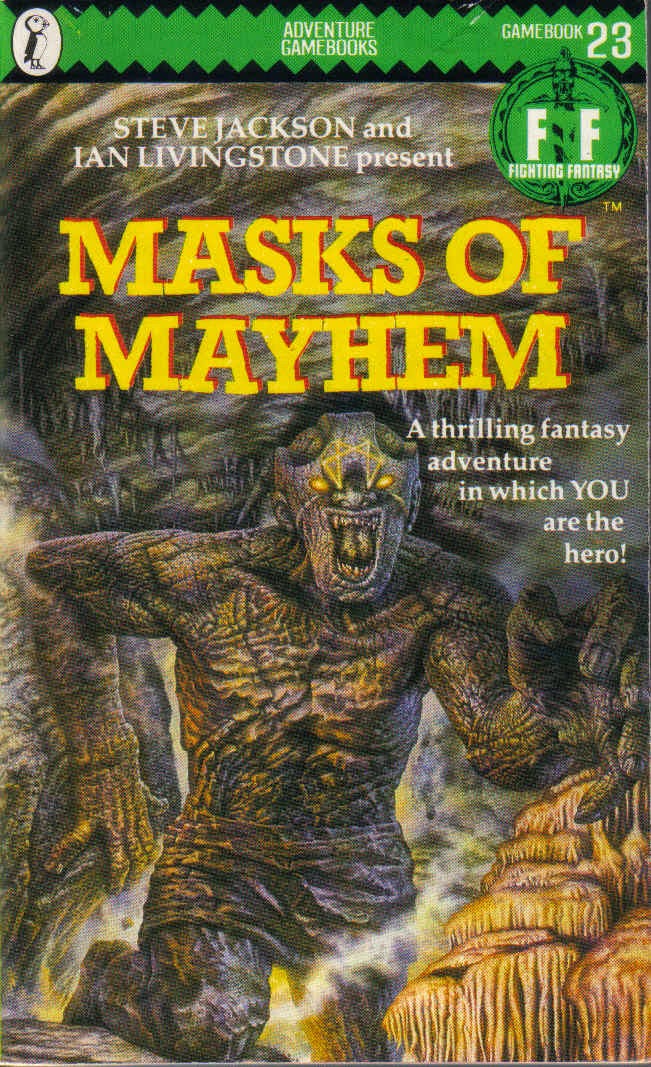
with this one and some of his best internal art is on show. If you get fed up of dying all the time, the art will hold up in itself and he mixes the style seen in his early FFs with a darker-looking more intricate approach in places, making this a really nice selection of varied art that shows nuances such as day and night or intelligence/stupidity of encounters very well. John Sibbick’s cover focuses on one of the Golems which, whilst they are part of the main purpose of your mission, only actually get one paragraph given to them of actual adventure so it is useful to be able to visualise them via the cover. There’s an elemental earthiness to the cover image and the weird all-important sigil is highlighted so the cover ultimately complements the plot and adds another layer of richness in your being able to “see” what is happening.

Masks Of Mayhem is not an easy book to summarise. Its design and ongoing interest make it a winner, but RW’s total disregard for player enjoyment due to it simply being unfair also makes it very hard not to get fed-up with it. This should have been a great book, but sadly it just ends up being frustrating. Appreciate the superlative plot and the art, but hate the fact that death or not finding enough number clues will get boring after a while. This deserved to be so much better...

Thursday, 10 July 2014

#25: Beneath Nightmare Castle


BENEATH NIGHTMARE CASTLE

Peter Darvill-Evans

Reviewed by Mark Lain

Book #25 in the original series is something of a turning-point. It was the first to be released with the gold dragon cover and was the last one I got on initial release. I don’t know whether the move from the iconic green zigzag cover design did for me, or if I was just moving onto other things then, but it would be several years before I would return to the series. Stylistically and thematically this was a major swing and heralded what was to come in the more adventurous books from the 30s and (especially) the 40s parts of the series. This was the first “what the hell is going on?” book, where you really have no idea what you are trying to achieve until you start to play. Previously, the FF books’ premises were laid-out on a plate and the point was basically just to win, rather than to figure the mystery out and then win. Here the notion is introduced of gradually unravelling a mystery and allowing the story to develop as you explore, rather than submerging yourself in a pre-defined idea (although a key NPC encounter early on can tell you everything you really need to know and also that you are a “chosen one” figure.) It is also the first genuinely dark and often disturbing FF book. Granted, #10 House Of Hell was quite frightening, but in an Old Dark House, Grand Guignol sense. The terror is presented in a rather more unsettling fashion in BNC, and there are some very warped recurring motifs and regular use of repulsion-inducing terms such as “protoplasm”, “slime”, “tentacles”, “ooze”, “acid”, and “glutinous”. Also, the instant deaths are presented in unusually long (for deaths) paragraphs that relish in describing in graphic detail exactly how horribly you are dying. Some have suggested that this is a full-on Horror genre piece, but I disagree – this is still Fantasy writing, but in its darkest, Call Of Cthulhu-esque form. There is certainly a sense of the Gothic in the exterior sequences, but the “dungeon” parts (which are the bulk of the book) are very dark Fantasy, possibly too dark for some as this book does verge on the potentially disgusting in places, but this is still Fantasy all the same. A good parallel would be with David Cronenberg films. It is too easy to simply call his movies “Horror” as they exploit a darker part of the human imagination, a sort of “Body Horror” that often involves a lot of stomach-turning slime and ooze. BNC is the FF version of a Cronenberg movie. It is the darkest kind of fantasy, too complex to be all-out Horror, but too nasty to be traditional “cosy” Tolkien fare. Put simply, there is something very interesting going on here in that FF is being moved into more adult territory that would herald the experimental and often structurally complex books that were soon to come.

The first thing that strikes the reader on embarking on this adventure is a sense that this is not going to be very easy at all. The first line of the introduction tells you that you have been captured in a net-trap which immediately puts you into a defensive position of peril. What follows is the need to get out of a prison cell, then to explore the Khul town of Neuburg and unravel whatever obvious nastiness seems to be hanging over the place. YOU play the role of a friend of the Margrave of Neuburg Keep so there is a human interest element in that you are fundamentally seeking to help an old friend out. The problem is you don’t know what it is yet that you are trying to help him out of and you need to establish what has happened to the town and then rid the town of the unknown unpleasantness. There is a malignant presence everywhere you go in the form of “Southerners” who wear desert-style robes and have partially-covered faces to add a sense of mystery. As you delve deeper you discover that they have “pets” called Blood-Lurchers which are horrific dog-abominations with tentacles and a serious bloodlust. These creatures stalk about at night which means the place is pretty much deserted after dark (all windows and doors are described as boarded-up), adding bucket-loads of atmosphere, which is both mysterious and worrying. Once you’ve explored the town you will inevitably find your way to Neuburg Keep itself which is where the adventure goes from being an atmospheric and unsettling mood piece to a genuinely disturbing goo-fest. But it does all flow logically and makes sense once you discover the nature of the source of the blight (an amorphous multi-appendaged jelly called Xakhaz.)

Given the sheer unfolding evidence of the nastiness of whatever is infesting the Keep, this book is understandably very difficult and you are set up from the word “go” as feeling rather out of your depth. It’s a sign of a tough FF that you can die at three different points in the opening half a dozen or so paragraphs (the beginning is actually extremely tough to get through on initial attempts) and there is no let-up at any stage, with instant fails/deaths around almost every corner (I count 47), numerous Luck tests that often lead to death if you fail, and the very neat inclusion of a new stat, Willpower. Unlike many additional rules in other books, the Willpower concept really adds depth to the flow of this adventure. You roll it up by rolling 1d6 and adding 6 (ie range is 7-12) and it is regularly tested once you enter the Keep in the same way Luck is tested, including deducting a point every time you test it. It works so well because it effectively controls your grip on sanity. Given the twisted imagery and hideous creatures that you face in the Keep a measure of how much it is all getting to you mentally draws you in very effectively. If your Willpower drops below 6 and you subsequently fail a Willpower test you will go bonkers instantly, and this can happen at any number of key points that either drive the main elements of the plot or that are just bloody horrible. OK, it’s very similar to Fear in House Of Hell, but it is more imaginative to lose by going mad rather than by dropping dead from fright and it feels more satisfying and appropriate in context. Whilst losing by failing a Willpower test is one of the more likely ways in which you will repeatedly find yourself having to start over, there are also four occurrences of extremely difficult tests against combined attributes, which is something rarely seen in FFs: there are two different situations that involve rolling 8d6 (yes, eight!) against your combined Skill and Stamina, a further scenario with 8d6 rolled against your combined Willpower and Stamina, and an only very slightly more forgiving roll of 5d6 against your combined Luck and Skill. The first three would give a rolled-up number range of 8-48 against a maximum combined attribute score of 36, and the marginally more lenient test gives you slightly more hope with a range of 5-36 against combined stats of maximum 24. This is an unusual idea for FF, but does come across as weighted against you.

What is quite interesting, though, is that, in spite of the very real difficulty of this book, there are some contrasting moments of generosity that make it feel fair, if undeniably very hard all the same overall:
  • ·         The rules do not mention any limit to your Skill score. Stamina, Luck and Willpower are explicitly stated as not being allowed to exceed their Initial values unless told otherwise, but Skill is not and if you can find certain helpful key items you can have a potential Skill of an incredibly high 18!
  • ·         Ditto, if you pass an “ordeal” early on, you can increase your Initial Stamina and Willpower by 2 points each
  • ·         Very few combats are especially tough and most enemies have stats under 10, meaning the usual lie about winning with poor stats is actually true here (although a high Willpower is pretty essential)
  • ·         The final baddie (Xakhaz) normally has incredibly high stats of Sk 14 St 32 which may seem interminable odds, but the Trident of Skarloz allows you to inflict -5 St damage on him in addition to the usual 2 (ie -7 per successful hit), drinking the Berserk Rage Potion ups your Skill by 4 points, and the Talisman of Loth reduces his Skill by 1, meaning, if you have all this kit, he is actually an enemy that can be killed quite easily. Plus, if you throw a green orb (bomb) at him he starts the fight with Sk 9 St 10 and then you can kill him in two attack rounds

Unusually as well (for such a hard book) is the realisation after several playthroughs that there is more than one route through this. The truest path certainly is far less dangerous, but is not very easy to find and is very tight, which makes the existence of the rather more perilous alternative routes all the more welcome and reduces the usual feeling of hopelessness that the books that lean towards the tougher end of the FF difficulty spectrum often leave you with after umpteen unsuccessful attempts. Naturally, this also adds more scope for re-playing even after completing the book and you will want to re-play this to experience as much as possible of its atmosphere and its best feature by far, its sheer inventiveness.

The majority of the encounters in this FF, especially those in the castle, are like nothing you will ever see in any other FF book and, if you can stomach them, they are well-worth seeking-out. The aforementioned tentacle-mouthed Blood-Lurchers act as an initial glimpse of the warped concepts that are to come further along, including a Snuff Hound (a hairless dog with a long nose), Chrabats (zombie mutants that look like frogmen), the Vlodbad (another multi-armed jelly that can sprout more arms each Attack Round), a Mutated Woman (the result of a viral experiment that has caused her to have, unsurprisingly, a mouthful of tentacles), the Bakk-Ruman (a legendary bat-humanoid-dog with massive blind eyes), and a crateful of animated bodyparts (with Stamina 18 as there are so many of them!) My personal favourite, however, has to be the Vitriol Essence, effectively the slimey embodiment of aggression that is not impressed at having been disturbed and does you -4 St damage with its acidic talons, which can then result in the pain driving you insane.

If all this isn’t weird/nasty enough, there are also some moments that border on being quite grim, especially the occasions where you have to ruthlessly kill children (one being the result of a failed Luck test at an early stage that more or less means you have lost much later on), an encounter in a prison cell with two people who have been infected with a disfiguring disease (the Mutated Woman and her slightly less disfigured brother) that you can potentially also catch, the amount of experimentation in general that Xakhaz has perpetrated on innocents, and the often macabre deaths that you can suffer, particularly those involving acid and/or corrosive oozes of various kinds, plus there are numerous opportunities to get executed or sacrificed.

An important point to mention, though, is that the often excessively graphic moments are off-set against a lot of very black comedy along the way. You can find a battle axe that turns you psychotic meaning you must always select the fight option if it is offered and you can never escape a combat (which can lead to killing some helpful characters by accident) although you do get a +2 Skill bonus if you have it, a Weightloss Potion that bans you from eating Provisions for the rest of the adventure, you can accidentally get turned into a tree, and/or can end-up being killed by becoming the target in the Southern “Warriors’ nightly “dropping a rock on the prisoner” game. Indeed, Peter Darvill-Evans’ writing is punctuated throughout with a wry darkly-humorous tone and he makes every effort to add as much depth and colour to his descriptive passages as possible (even if it does emphasise the nastiness in parts) and you really do feel the corrupting influence within the Keep, with its walls that drip slime, and its balance of both obviously abandoned and obviously in-use areas. His choice of vocabulary is intentionally oppressive and he seems keen to make sure that we appreciate just how many different words for “ooze” he knows, but it definitely pays-off and sets the exact atmosphere that he was obviously aiming for.

It is to PD-E’s credit that he also manages to design a well-structured gamebook. The Willpower rule works very effectively, as does the differentiation between your potentially sky-high Skill whilst restricting other stats to make you vulnerable whilst still giving you a chance of survival. There is a semi-ambiguity in how to use Provisions, but basically you can only eat when the book says so. Whilst on the topic of Provisions, we see a rare moment where your backpack comes into play – if you decide to take a piece of Blood-Lurcher mouth tentacle you will discover that it has taken its chance to eat all your supply of food whilst it was in your backpack. More black humour and an added cause-and-effect moment, which adds more logical depth to the proceedings. The initial section in the town itself is handled almost in a RPG fashion whereby you are able to visit all three parts in any order should you feel inclined, rather than being limited to one or two. Again this increases the routing and replay possibilities, and it is nice to see a FF that isn’t too restrictive and linear. Yes, there are three or four inevitable points along the way that all the routes will incorporate, but they are key to the plot and it would make no sense at all if you didn’t have to penetrate the Keep entrance somehow, or kill Senyakhaz (Xakhaz’ similarly-named female facilitator) to be able to access the underworld where Xakhaz is lurking, and one of the real design treats comes at this stage where you have a choice of two possible “routes” into the underworld, one which is a direct entry, the other (the more interesting one by far) involves rolling a die and either losing immediately, getting sent to the correct destination, being fired into another dimension entirely, and, my favourite, going back in time and having to re-defeat Senyakhaz and attempt the portal a second time. Very imaginative.

Even the title of this book is an intriguing departure from the previous FF norm of either a character heading (Space Assassin, Freeway Fighter, The Warlock Of Firetop Mountain, etc) an abstract overall location (The Forest Of Doom, Rebel Planet, Temple Of Terror, etc), or the plot-driving object (Masks Of Mayhem, Sword Of The Samurai, etc) in that the title is a very specific preposition telling you that you are going Beneath Nightmare Castle. No other FF title is quite so literal in its setting-out of exactly where you can expect to find yourself and it is all the more effective when you discover just how little you know about your mission in the early stages. To add effect, the cover is a well-drawn night image (dark blue and black hues with a massive moon in the middle) which adds to the “nightmare” idea, and the contents are certainly the stuff of nightmares. My only qualm with the otherwise very well-worked combination of cover art and title is the girl in spiked armour reaching threateningly towards you as this does not happen anywhere in the book (at least not like this, anyway.) Instead, if you find the girl, she is hidden in a cell deep within the Keep (not outside), is chained to the wall, is in tears, and you do not have to fight her. In fact, it is discouraged to do so and you are left feeling a little morally empty if you do kill her. However, should you pick up on it, incidentally, the victory section (400) can seem a little odd in continuity terms if you do let her live, as you are made heir to the Keep and no mention is made of her which is strange as she is actually the Margrave’s daughter. I guess the parts of Khul with Germanic naming conventions (ie the Darvill-Evans’ FF set parts!) operate the rather more traditional and archaic system of chauvinistic succession, then?

The internal art (by Dave Carson) is a mixed-bag. In parts it brilliantly visualises the hideousness of what you are faced with (lots of tentacles and dripping things, and the Bakk-Ruman gets a special mention for being a brilliant drawing), whilst in others it is a little too starkly black-and-white with only limited detail to bring things to life. If it is intended to emphasize the bright horrors against the dark dank insides of the Keep then this works well, but there are moments that could be more artistically fleshed-out here and there. On the whole though, your imagination is already running riot at PD-E’s lengthy descriptions of everything so you are probably less likely to rely on drawings to create the image. On a historical note, there was meant to be a picture of the Mutated Woman’s tentacle-riddled mouth, but it was censored out due to being too graphic – this book was (incredibly, considering its very lurid nature), after all, meant for children!

In summary, then this is a very good, if excessively horrific, FF book. It is very difficult, but is also very balanced and extremely well-designed. The extra rules actually add something for once and the intended effect and concept is so well-rendered that you can’t help but really feel involved in the story. It will take many attempts to beat it, but it rewards replays and, assuming you have the stomach for it, everything along the way is worth exploring. Well worth discovering and/or re-discovering.